Monday, March 23, 2015

Pater Noster?


 On the feast of St. Joseph, March 19, 2015, Bishop Richard Williamson consecrated Fr. Jean-Michel Faure as a new Traditionalist Bishop. Pseudo-Traditionalist is more accurate. Bp. Williamson was one of the four priests consecrated by Archbishop Marcel Lefebvre in 1988 for the Society of St. Pius X (SSPX). The position of the SSPX has always been a rejection of sedevacantism and sedeprivationism. They hold the "recognize and resist" idea that you can recognize the post-Vatican II "popes" as legitimate Vicars of Christ, and yet "resist" their errors. In 2012, Bp. Williamson was expelled from the SSPX for his criticism of General Superior Bp. Bernard Fellay in his efforts to reconcile the SSPX to the Modernist Vatican. In reaction to Bp. Fellay's "dialogue" with Rome, Williamson founded the Society of St. Pius X of the Strict Observance (SSPX-SO).

 Did Bp. Williamson, and the priests who followed him out of the SSPX, embrace sedevacantism? No! They simply will do what the SSPX has been doing without the negotiations with "Pope" Francis. I've criticized Bp. Williamson quite a bit in my posts for his inconsistent positions and (at times) whacky ideas/behavior. The priest he consecrated, Bp. Faure, is only two years Williamson's junior at age 73. You would think he would choose a successor a bit younger. That being said, why the need for this consecration? Remember, if there is a pope, you need a papal mandate for a bishop to be consecrated. Therefore, Williamson and Faure find themselves excommunicated from their "pope." (For Bp. Williamson it's the second time; the first was  by JPII after his 1988 consecration, and it was rescinded by Ratzinger in 2009). In place of a mandate from Francis, Bp. Williamson produced one of his own making (!) which reads as follows:

" We have a Mandate to consecrate from the Roman Church which in its fidelity to Sacred Tradition received from the Apostles commands us to hand down faithfully that Sacred Tradition – namely the Deposit of the Faith – to all men by reason of their duty to save their souls.

For indeed, on the one hand, the authorities of the Church of Rome from the Second Vatican Council down to today are driven by a spirit of modernism which undermines in depth Sacred Tradition to the point of twisting its very notion: There shall be a time when they will not endure sound doctrine, turning away their hearing from the truth, turning unto fables, as St Paul says to Timothy in his second Epistle (IV, 3,5). What use would it be to ask such authorities for a Mandate to consecrate a bishop who is going to be profoundly opposed to their most grave error?

And, on the other hand, to obtain such a bishop the few Catholics who understand his importance might have hoped, even after Vatican II, that he could come from the Society of St Pius X founded by Archbishop Marcel Lefebvre, like the four consecrated for them in 1988 by a previous emergency Mandate. Alas, when the authorities of that Society showed by their constant turning towards the Roman authorities that they were taking the same modernist road, that hope proved to be vain.

From where then could these faithful Catholics obtain the bishops essential to the survival of their true faith? In a world making political war day by day more on God and on His Church, the danger for the Faith seems such that its survival can no longer be left to depend on a single fully anti-modernist bishop. The Church herself asks him to appoint an associate, who will be Father Jean-Michel Faure.

By this handing down of the episcopal power of Orders, no episcopal power of jurisdiction is assumed or granted, and as soon as God intervenes to save His Church, which has no more human hope of rescue, the effects of this consecration and of its emergency Mandate will be without delay put back in the hands of a Pope once more wholly Catholic."

 You might ask, "How does this jive with the "recognize and resist" idea that Francis is pope? Answer: It doesn't. Bp. Williamson continuously makes gratuitous assertions without one iota of theology and canon law to back them up. Everything he does runs strictly counter to what the Church teaches through Her approved theologians.

Here's what the Church teaches:

1. The Pope has Universal and Complete Primacy Over the Entire Church

 The name "pope" comes from the Greek word for "father." Like an earthly father rules over the family, the Holy Father does the same for the Church in a more absolute manner. As taught by theologian Van Noort, the pope's power (as defined by the Vatican Council in 1870) is:

  • binding authority which demands obedience
  • universal in regard to place (everywhere) and business (faith, morals, discipline, and government)
  • ordinary--i.e., he possess his jurisdiction over the Church by virtue of the office he holds and may exercise it at any time he chooses
  • direct and episcopal--he can act not only on individual bishops but also on the faithful without any episcopal mediation
  • supreme--there is no other person (or persons taken collectively) that have a power greater than or equal to his
  •  absolute and complete in itself. He possesses in himself alone the plenitude of power, and not merely a portion of that power (See Van Noort, Dogmatic Theology 2:280-282)
2.  The Church, with the Pope as Her visible Head on Earth, is indefectible. Her teaching cannot change, and because She is infallible, Her laws cannot give evil

Again, from Van Noort:

"The Church's infallibility extends to the general discipline of the Church. ...But if the Church could make a mistake in the manner alleged when it legislated for the general discipline, it would no longer be either a loyal guardian of revealed doctrine or a trustworthy teacher of the Christian way of life." (Dogmatic Theology 2:114-115; Emphasis in original) Therefore all of what the Church legislates with papal approval is infallible; it cannot be evil or in error.

3. Rejection of a Command or Decision of a Pope Can Happen In One of Three Ways:


  • Rejection of the thing commanded. This occurs when one disobeys something ( e.g., a fast or restitution enjoined by the Pontiff) because he considers it too difficult. This results in sin, but not separation through schism because he rejects a commandment of the Church, not the Head of the Church.
  • Rejection of the command when you regard the pope in his capacity as an individual. As the pope is not above human weakness, he might make a command moved by hatred, envy, or some other sinful motive involving an individual decision (not one affecting the whole Church). The pope might also command something sinful (e.g., kill someone he dislikes). In such a case neither sin nor schism is committed by this refusal to obey. 
  • The rejection is based on his official capacity as pope. The person is guilty of schism and is no longer a member of the Church because he does not wish to submit to the authority of the pope who gave the command. (See theologians McHugh and Callan, Moral Theology 1: 542-543)

 Now, let's consider the "mandate" of  Williamson when analysed under these principles. 

Para. #1: We have a Mandate to consecrate from the Roman Church which in its fidelity to Sacred Tradition received from the Apostles commands us to hand down faithfully that Sacred Tradition – namely the Deposit of the Faith – to all men by reason of their duty to save their souls.

The Roman Catholic Church acts through Her visible Head, the pope, under normal circumstances. How can you get a mandate from the Church when you recognize Francis and he has not consented to give you one?  Are you suggesting the pope gave something evil? See principle #2 above. 

 Para. #2 For indeed, on the one hand, the authorities of the Church of Rome from the Second Vatican Council down to today are driven by a spirit of modernism which undermines in depth Sacred Tradition to the point of twisting its very notion: There shall be a time when they will not endure sound doctrine, turning away their hearing from the truth, turning unto fables, as St Paul says to Timothy in his second Epistle (IV, 3,5). What use would it be to ask such authorities for a Mandate to consecrate a bishop who is going to be profoundly opposed to their most grave error?

The authorities--including the man they consider "pope" is in "grave error" that needs to be opposed? See principle #2 above. The Holy Ghost would not permit the pope to teach a "most grave error" and to be driven by "a spirit of Modernism" which is heresy.

Para. #3 And, on the other hand, to obtain such a bishop the few Catholics who understand his importance might have hoped, even after Vatican II, that he could come from the Society of St Pius X founded by Archbishop Marcel Lefebvre, like the four consecrated for them in 1988 by a previous emergency Mandate. Alas, when the authorities of that Society showed by their constant turning towards the Roman authorities that they were taking the same modernist road, that hope proved to be vain.

Lefebvre made up a "mandate" too! Salvation came not from the pope and his hierarchy with ordinary jurisdiction established by Christ, but through the SSPX set up in opposition to the appointed hierarchy! Now they "defected" by----wanting to be united to the pope??

Para. #4 From where then could these faithful Catholics obtain the bishops essential to the survival of their true faith? (How about from the pope?)In a world making political war day by day more on God and on His Church, the danger for the Faith seems such that its survival can no longer be left to depend on a single fully anti-modernist bishop(You mean the pope is not ant-Modernist? That would make him a heretic! But a heretic can't be pope, so he's either anti-Modernist, or a false "pope."). The Church herself asks him to appoint an associate, who will be Father Jean-Michel Faure.(The Church--apart from the pope--asked for Fr. Faure to be consecrated? Imagine that!)

Para. #5 By this handing down of the episcopal power of Orders, no episcopal power of jurisdiction is assumed or granted, and as soon as God intervenes to save His Church, which has no more human hope of rescue, the effects of this consecration and of its emergency Mandate will be without delay put back in the hands of a Pope once more wholly Catholic."

You mean we have a "partially Catholic" pope? Sounds like Vatican II ecclesiology! Doesn't Williamson reject the idea of non-Catholic sects being in "partial communion" with the Catholic Church ---as the heretical teachings of Vatican II tell us? Yet it seems Mr. Bergoglio can be in "partial communion" with the office of the papacy!

 Bp. Williamson, and the newly consecrated Bp. Faure are of a Protestant mind- set. They recognize a man as pope, then apply their own made up principles (alien to the Catholic Faith) to justify doing what they want. Then they go about as they please in the hopes that some day Bergoglio (or his successor) will do what they think is right. How sad.. Only when there is a general rejection of the errors of Vatican II sect and its false "pope" can we come closer to an imperfect general council electing a real Pontiff whom we can obey and call "our father."

Monday, March 16, 2015

When "Orthodox" Is Only A Noun


 There is a movement by some, who are disgusted by the Vatican II sect, to join the Eastern Orthodox. The appeal is understandable. They have retained the beautiful Divine Liturgy of the East, they have retained all seven sacraments with a reverence for the sacred, and they are not plagued by the rampant sodomite/pedophilia scandal emanating from Modernist Rome. Now, there are even some who openly proselytize for the Orthodox. They talk about how they have stability and do not fight among themselves, unlike Traditionalists. They have "no use" for a pope either, and did you know that popes and Councils have contradicted each other prior to Vatican II? The Orthodox (noun) are truly orthodox (adjective)---so these apologists claim.

 Time for a serious reality check. Often the Eastern Orthodox will be incorrectly described as "schismatic." They do not merely refuse to submit to the Roman Pontiff as schismatics, they are heretics as they deny at least three dogmas of Divine and Catholic Faith. They deny:

  • that the Holy Ghost proceeds from BOTH God the Father and God the Son (hence the refusal to use the "Filioque" in the Creed; i.e., "and the Son.")
  • the Immaculate Conception of the Most Blessed Virgin Mary (defined December 8, 1854 by Pope Pius IX)
  • the Primacy and Infallibility of the Roman Pontiff (as decreed by the Vatican Council on July 18, 1870)  
 There are other problems as well, but those are the most serious. Let it first be noted that Traditionalists do NOT "deny the pope." We deny that the post-Vatican II "popes" are, in fact, the pope because they are notorious and contumacious heretics. A heretic cannot be pope. The papacy will endure until the end of the world but we don't need to have an actual man filling the position at all times. According to theologian Dorsch:

 “The Church therefore is a society that is essentially monarchical. But this does not prevent the Church, for a short time after the death of a pope, or even for many years, from remaining deprived of her head. [vel etiam per plures annos capite suo destituta manet]. Her monarchical form also remains intact in this state.…


“Thus the Church is then indeed a headless body.… Her monarchical form of government remains, though then in a different way — that is, it remains incomplete and to be completed. The ordering of the whole to submission to her Primate is present, even though actual submission is not…

“For this reason, the See of Rome is rightly said to remain after the person sitting in it has died — for the See of Rome consists essentially in the rights of the Primate.

“These rights are an essential and necessary element of the Church. With them, moreover, the Primacy then continues, at least morally. The perennial physical presence of the person of the head, however, [perennitas autem physica personis principis] is not so strictly necessary.” (de Ecclesia 2:196–7)

Also, according to theologian Salaverri, instead of being a “primary foundation… without which the Church could not exist,” the pope is a “secondary foundation,” “ministerial,” who exercises his power as someone else’s (Christ’s) representative. (See De Ecclesia 1:448)

Traditionalists are either sedevacantists or sedeprivationists; both of whom deny that Jorge Bergoglio (Francis) is a true pope, but neither deny the institution of the papacy as defined by the Church's own approved pre-Vatican II theologians. As to Traditionalists having disputes (as to sedevacantism, sedeprivationism, "recognize and resist" of the pseudo-Traditionalist SSPX, etc) this is to be expected because when "the Shepard is struck, the sheep will scatter" (See  Zechariah 13:7). For the record, I do not consider conclavists (those who believe they can just go out and "elect" a so-called "pope") to be Traditionalists. They adhere formally to a false pope, the same as members of the Vatican II sect.

 This post will sketch the controversy surrounding the "Filioque" which the modern day Orthodox proselytizers use to batter Traditionalists. This is a condensation of the Church's Teaching as expounded by theologian Pohle.

1. Origin of the Heresy
 When the Macedonian heretics declared the Holy Ghost to be a creature of the Logos-Son, the Second Ecumenical Council (Constantinople I--381 A.D.), in order to safeguard the dogma of His Divinity, thought it was sufficient to affirm His Consubstantiality (of the same substance) with God the Father in the phrase "Qui ex Patre procedit" ("Who proceeds from the Father"). Sometime after the Council, certain heretics came to believe that "ex Patre" ("from the Father") meant "Ex solo Patre" (from the Father alone").  It was left to the heretical Patriarch of Constantinople, Photius, to raise the banner against the Church for inserting the word "Filioque" into the Nicean Creed. A great council (non-ecumenical) was held in Constantinople in 879 A.D. which was attended by 380 bishops of the East and formally pronounced sentence of anathema against all who should add to, or take from, the Creed of Nicea. 

 Though the Ecumenical Council of Chalcedon (451 A.D.) had forbidden the reception into the Creed of "any other Faith" it can only have meant heterodox additions. The First Council of Constantinople would add many clauses expanding the original Nicene Creed, including clauses that state the Holy Ghost "proceeded from the Father" (as explained above), and "I believe in One, Holy, Catholic, and Apostolic Church." Thus history proves there was no absolute ban on doctrinal clarifications considered necessary to combat serious errors. I find it supremely ironic that the Latin text of the Creed with "Filioque" has retained "Theon ek Theon" ("God from God") while the Greek text used by the Eastern Orthodox has eliminated those words from the very Creed they claim cannot have ANY change! They stand condemned by their own invented principle! 

 2. Scriptural Argument

 Sacred Scripture expressly mentions only the procession of the Holy Ghost from the Father. (See St. John 15:26) However, the Procession of the Holy Ghost from the Son can be proved by a three-fold argument from Biblical texts. 

  • In the New Testament, the Holy Ghost is not only represented as "the Spirit of the Father," but also as "the Spirit of the Son." (See Galatians 4:6, Romans 8:9, Phil. 1:19, I Peter 1:11).  The Orthodox admit the only reason why the Holy Ghost can be called "the Spirit of the Father" (See St. Matt. 10:20) is because He proceeds from the Father. If this be true, it must be a pari  concluded that He can be called "the Spirit of the Son" because He also proceeds from the Son. This conclusion is fortified by Christ being called "the Son of the Father" (Filius Dei) which evidently expresses a procession One from the Other. 

  • A stronger argument can be drawn from what is known as the "Mission" of the Holy Ghost. Missio, in the abstract sense, signifies "the procession of one from another by virtue of some principle and for the purpose of accomplishing some task." There are three essential notes of any mission, human or Divine: (1.) A real distinction between the sender and the one sent, for no being can send itself (2.) A certain dependency of the "sent" in regards to the "sender." (3.) A relation on the part of the "sent" to some place or effect. In the Divinity any influence of the "Sender" on the "Sent" --other than by relation of origin, would be repugnant to the Essense of the Triune God. The eternal Procession of one Divine Person from another may be called "Internal Mission" and the Temporal Mission is external and merely reflects the Internal. In Scripture, the Father is always represented as "sending" but never as "sent." The Son is both "sent" and "sending." The Holy Ghost is only "sent" and never "sending." The Son is sent by the Father, because the Son is begotten by the Father, not the Father by the Son; similarly, we read that the Holy Ghost is sent by the Father and the Son, because He proceeds from both the Father and the Son.  (See St. John 14:16, St. John 15:26, and St. John 16:7--See also theologian Franzelin, De Deo Trino, thesis 33). 

  • In St. John 16:13 sqq, it is said that the Holy Ghost "hears" and "receives" His knowledge of the future from Christ. Now, one Divine Person can "hear" and "receive" from another only in so far as He does not, like the Father, possess His knowledge, and consequently His essence, from Himself, but receives it by way of of essential, eternal communication. Hence, just as Christ "hears" and "learns" from His Father only in so far as His Divine Nature with all the attributes of omnipotence, omniscience, etc, are communicated to Him by His eternal Generation from the Father; so, too, the Holy Ghost "hears" and "receives" from the Son only in the sense that all His knowledge and His whole Essence are derived through origination from Christ. Consequently, the Holy Ghost proceeds from the Son as well as from the Father.

2.  Patristic Argument

 The Eastern Orthodox freely admit that the Latin Fathers unanimously teach the procession of the Holy Ghost from the Father and the Son. In making this admission, they condemn themselves. It is absurd to imagine that the Latin Church, which for eight centuries together with the East formed the One True Church of Christ, should have harbored and taught so disgraceful a heresy during all that time! 


In summation, do not be lead astray by those heretics calling themselves "Orthodox."  Just as you can call an unborn baby a "product of conception," and it does not detract from his/her humanity,  you can likewise call heresy "Orthodox," but it makes those who adhere to it heretics nonetheless. 

Monday, March 9, 2015

Celebrating Our Own Demise


"The Quran should be the highest authority in America, and Islam the only accepted religion on Earth."
- Omar Ahmed, Chairman of the Board of CAIR (The Council on American-Islamic Relations)

 Here In New York City, Mayor Bill de Blasio announced that the Big Apple would become the nation's first major city to close the public schools in observance of the two most "holy" days for Moslems, Eid al-Fitr, and Eid al-Adha. I wonder if Pope Pius XI, who composed the most beautiful prayer of the Consecration of the Human Race to the Most Sacred Heart of Jesus, could have imagined such a state of affairs. The prayer asks for the conversion of those "in the darkness of idolatry or of Islamism." (Of course the Vatican II sect eliminated the prayer which was ordered to be recited every October on the Feast of Christ the King).

 De Blasio is quoted as saying, "People who criticize it (the closing of schools on Moslem "holy" days), I think, should go back and look at the Constitution of the United States. We are a nation that was built to be multi-faith, multicultural." While it's true the US Constitution is full of Masonic ideals (like indifferentism--the idea that one religion is as good as another), I challenge anyone to show me where it states that we must give all religions the honor of holidays. It's probably written next to the part that states women have a right to kill their unborn children. What about holidays for Buddhists, Hindus, Wiccans, and even Satanists? Let's not forget that almost all of the people in the US in 1787 were professing some sect of Christianity (and some were members of the True Church as well), so it's obvious why Christmas and Easter were celebrated. The Constitution may allow you to honor what you like, but it does not enjoin official recognition.

 Antipope Francis has written in his "encyclical" Evangelii Gaudium paragraph #253: ...We Christians should embrace with affection and respect Muslim immigrants into our countries..." Really? Here is just a partial listing of what Moslems in this country have done to achieve their purpose of the "Islamification" of the West and the destruction of all forms of Christianity:


  • CSCOPE Curriculum (being used in 70-80% of Texas schools) teaches "Allah is the Almighty God," the Boston Tea Party was conducted by "terrorists" and frames 9-11 attackers  as "freedom fighters." Concerned parents were told they could not see the curriculum and were accused of being "bigots." (See http://www.wnd.com/2012/12/texas-teaching-allah-is-the-almighty-god/ and http://www.wnd.com/2013/02/students-made-to-wear-burqas-in-u-s-state/)
  •  A Dearborn, Michigan, McDonald's Restaurant was sued over alleged Halal (Muslim sensitive) meals. $700,000 was awarded. Meat served in Halal meals must be slaughtered in the name of Allah. (See http://www.onenewsnow.com/business/2013/01/23/a-meals-not-happy-if-its-not-halal#.VPpTxPldVj4)
  • Pressured by Islamic leaders, the Obama Administration eliminates mention of "Islamic Terrorism" or any negative mention of Islam, including simple quotes from the Qur'an - from CIA, FBI, Homeland Security, and US Military Training Manuals (Nov. 2011). (See http://www.judicialwatch.org/blog/2012/02/u-s-bans-linking-terrorism-to-muslims-in-agent-training/) 
 Meanwhile, Frankie goes and prays to the false god Allah! As reported by the Wall Street Journal:
"On the second of a three-day trip to Turkey, the pontiff removed his shoes before entering the Sultan Ahmet Mosque, known as the Blue Mosque for the blue tiles embellishing its walls. After a tour of the cavernous 17th-century mosque, he stood alongside Istanbul Grand Mufti Rahmi Yaran, facing in the direction of Mecca, and bowed his head in long prayer." (See http://www.wsj.com/articles/pope-francis-prays-in-mosque-in-sign-of-commitment-to-christian-muslim-relations-1417282839) 

 The Modernists and the political left are quick to brand any opposition to Islam a mental disorder, i.e., "Islamophobia," just as opposition to the sodomite agenda is "homophobia." The facts speak otherwise. Soon, the Moslems will overpopulate the contracepting Christians of the West, and accomplish what their huge armies in days gone by couldn't do. Ironically, what's happening now was condemned by Pope Gregory XVI in his encyclical Mirari Vos: "...and from this most putrid font of indifferentism flows that absurd and erroneous view, or rather insanity, that liberty of conscience should be asserted and claimed for just anyone." (Emphasis mine). 

 Not only are we giving Moslems liberty of conscience, we're celebrating their false and evil holidays. If Frankie and the loony left-wing aren't stopped, soon we will be in a country dominated by infidels and forced to pay homage to the "martyrs" of 9/11. 

Monday, March 2, 2015

The Burden Of Proof


Traditionalism is controversial by nature. Trying to wake people up to the fact that Jorge Bergoglio is not really the pope will spark no little amount of contention. Add to this the fact that, without a pope, there are issues within Traditionalism which cannot be resolved since there is no one who can give a final and binding decision.  "Roma Locuta Est, Causa Finita Est" (i.e. "Rome has spoken, the matter is concluded") is a thing of the past in a state of sedevacante. I don't believe in controversy for the sake of controversy itself. Unfortunately, there are those who do, and they relish attacking Traditionalist priests and bishops.These are not intellectual disagreements; instead they attack their character. True priests and bishops are not above reproach, and we must call them out on any major flaws so that a repeat of the 1950s " a cleric can do no wrong" mentality never again holds sway.

However, to publicly attack a Traditionalist priest or bishop's orders without serious justification is not merely calumny, but a grave injustice to those Traditionalist Catholics who fearing that these priests and bishops may not be valid clergy, stay away from the sacraments. This is exactly what happened at the blog Pistrina Liturgica (hereinafter "PL"). For a detailed summary, please see my posts of 4/22/13, 6/8/13, 7/14/13, and 10/19/13. In short summation, the webmaster, who goes by the moniker "The Reader," possesses a near pathological hatred for Fr. Anthony Cekada and Bishop Daniel Dolan, whom he constantly refers to as "One Hand Dan." The reason? It is alleged that when Bishop Dolan was ordained to the priesthood by Archbishop Lefevre in the 1970's, he only imposed one hand on his head instead of two. Fr. Dolan was one of the nine priests who broke away from the Society of St. Pius X to found the Society of St Pius V in 1983. After Fr. Dolan left the SSPV in 1989 over the issue of the Thuc consecrations, the remaining clergy in the SSPV sent a letter to him asking him to refrain from all further priestly functions because the Archbishop's use of only one hand instead of two made his ordination "dubious." (Interestingly, they never brought this point up when he was with them, only after he left!). In addition to my posts mentioned above, Fr Cekada published a refutation of the idea that ordination with one hand was dubious in his article entitled "The Validity of Ordination Conferred with One Hand." It can be found at traditionalmass.org.

 After one of my readers sent a comment about the fact PL was now sending out a pamphlet, in Q & A format, attacking his orders yet again, I went on PL and began asking in the comments for the names of the witnesses of this alleged one hand ordination. I wouldn't give up after a massive back and forth of trying to dodge my inquiry. Without at least one witness, whose identity is known and has signed a sworn statement, the entire discussion about the validity of priestly ordination conferred with one hand becomes moot. Catholic theology DEMANDS that there is a presumption the rite was validly and correctly performed, whenever a bishop ordains a man to the priesthood. “When the fact of ordination is duly established, the validity of the orders conferred is naturally to be presumed.” (W. Doheny, Canonical Procedure in Matrimonial Cases [Milwaukee: Bruce 1942] 2:72.) That means everything was done correctly--matter, form, and intention. Those who wish to impugn the validity of orders have the burden to show, with credible evidence that raises a reasonable doubt, that matter, form, or intention was lacking. This they have not done.

 It turns out The Reader's lackey, "The Watcher" has a blog of his own, also bashing Bp. Dolan and Fr. Cekada entitled The Lay Pulpit (hereinafter "LP").  It was brought to my attention that in his post of 1/3/15, LP attacked me and attempted to defend PL's assertion about one handed ordinations. Neither one is able to grasp the relatively simple concept of "having the burden of proof." They seek to hurt Bp. Dolan by casting doubt on his orders, and by extension, the orders of any priest  he ordains. This keeps good people away from the sacraments and hurts souls. I will reprint "The Watcher's" post from 1/3/15 entitled "A Moot Point" in red and will respond to each section below it without red color.


A recent Pistrina Liturgica article -- in addition to a whole series of earlier ones -- has dealt with the doubts about Daniel Dolan’s one-handed ordination.  In those earlier articles, Pistrina related how, after Dolan’s dubious ordination, nine priests (one-time colleagues of his) urged him to get those doubts resolved before continuing with his priestly duties, after which he responded by commissioning Anthony Cekada to write a tract arguing the validity of one-handed ordinations (which Pistrina then subsequently totally disproved and discredited).

As you will see in my posts listed above, PL hardly can be said to have "totally disproved and discredited" anything. None of the nine priests who signed the letter were at the ordination. One of them, Fr. Joseph Greenwell, was 12 years old in 1976 and living in Kentucky. He even admitted he signed the letter because Fr (now Bp.) Kelly simply told him to do so. They state, as a matter of fact, that a one-handed ordination took place with no personal knowledge and they name no witnesses. The doubt exists only in the imagination.

 This recent article dealt specifically with a contention by one of Dolan’s supporters that there was an “eye witness” who swore “before God” that Dannie was ordained with two hands, not one.  The problem is that this “eye witness” came forward to make his claim thirty-five years after the ordination – long after those nine priests had written their letter to Dolan.  Why, one might ask, didn’t he come forward then?  Pistrina pointed out this and several other problems with this “witness’s” account (which are detailed in the article). 

Bp. Dolan doesn't need a witness, HE does not carry the burden of proof because Abp. Lefebvre enjoys the presumption of validity under Church Law: The Principle:
Sacraments conferred by a Catholic minister, including Holy Orders, must be presumed valid until invalidity is proved. 

Proof:

This is “the queen of presumptions, which holds the act or contract as valid, until invalidity is proved.” (F. Wanenmacher, Canonical Evidence in Marriage Cases, [Philadelphia: Dolphin 1935], 408.)

“When the fact of ordination is duly established, the validity of the orders conferred is naturally to be presumed.” (W. Doheny, Canonical Procedure in Matrimonial Cases [Milwaukee: Bruce 1942] 2:72.)

Nevertheless, Bp. Dolan has a known, sworn witness that the ordination was done properly according to the rubrics. PL has nothing but conjecture from nine priests who weren't there and have no witnesses. PL claims to have witnesses (or witness, singular, depending on what things he wrote at different times) yet refuses to name them (or him/her). So what proof of a one handed ordination does PL have, ladies and gentlemen? None.

In response to this article, one of Dolan and Cekada’s supporters – one “Introibo” – wrote in as a “commenter” to challenge what Pistrina had to say.  Introibo started by saying that the nine priests’ testimony itself was fourteen years after the ordination, making it subject to doubt as well (strangely, though, he did not raise the same objection about his “witness’s” words, which were thirty-five years after the fact).  In the ensuing marathon of comments, Introibo, who happens to be a New York lawyer, went on to claim that he had a hard-and-fast witness, whereas Pistrina had none; and, being a lawyer, he then went on to claim that Pistrina had “no case” at all.  After repeated calls by Introibo for Pistrina to produce a “witness,” Pistrina responded by saying that there were witnesses to the one-handed ordination, but that they do not, for their own private reasons, wish to be identified – and hence, Pistrina is not at liberty to reveal their names.  Whereupon, Introibo, being a lawyer, seized upon this to contend (since Pistrina could not produce their names) that they did not exist -- and that Pistrina was lying about them (and everything else).

In one paragraph, The Watcher goes out of his way to state that I'm a lawyer no less than three times. While the term "lawyer" is a negative appellation for many, what I believe he's trying to accomplish is to show that I have some special training or specialized ideas as to what constitutes a "witness" and proof. In this case, it's not a matter of training,just simple common sense based on Church teaching. To wit:
  • It's plain logic that if you can impugn the reliability of a witness based on the length of time that passes between the event and his testimony, the fourteen years that passed between the ordination and the priests'  letter make it as unreliable as the statement from the witness thirty-five years after the fact. 
  • Bp. Dolan's witness was actually there at the 1976 ordination. The nine priests were not there and never even claimed to have any first hand witnesses. Which would you consider more reliable; a sworn statement from someone who was there at the event 35 years ago, or a letter written by nine priests 14 years after the fact and based on hearsay? 
  • I didn't raise any doubt about Bp. Dolan's witness because he doesn't even need one. I never claimed "I" had a "hard and fast witness." No witness is necessary because under Church Law the burden of proof is on the one seeking to cast doubt upon the validity of the sacrament.
  • If there were truly witnesses to a one-handed ordination, and they believed that this could raise doubt as to the validity of the sacrament, they have a grave duty in justice to make what they saw public. It would be sinful to withhold such information regarding validity when the salvation of souls could literally hang in the balance. Yet, for "private reasons" they will refuse to be identified. How convenient! All of them have compelling "private reasons" that surpass the duty to save souls! Remember that "Salus Animarum Est Suprema Lex" ("The salavtion of souls is the supreme law").
  • In the civil law, you have a Constitutional right to both know and confront any/all witnesses against you. The Confrontation Clause of the Sixth Amendment to the United States Constitution provides that "in all criminal prosecutions, the accused shall enjoy the right…to be confronted with the witnesses against him." In the absence of such confrontation, the witnesses testimony will be considered non-existent. In the instant case, we don't even know if such witnesses are real, let alone confronting them. The burden of proof must be high in Church Law as in criminal cases. Why? Can you imagine the bedlam if the Church allowed anyone who claimed without proof that "someone saw something" to call into question the validity of a sacrament? True Catholics must be morally certain that the sacraments they receive will be valid, unless there is credible evidence to the contrary. How credible are nameless, faceless "witnesses" to you?  There's more credibility in the man on the old Art Bell show who claims reptilian aliens in human form are controlling the world--- and he has witnesses--- but they can't speak or the aliens will kill them. 
If PL will cast doubt on the validity of the orders of a cleric based on conjecture, hearsay, and "secret witnesses," could you reasonably believe anything else he has to say about Bp. Dolan?

What Introibo failed to realize (or did not want to realize) is that there was no mention of such “witnesses” in the original Pistrina article – because there was no need to.  No such “witness” was necessary to prove doubt.  The fact that nine priests wrote to Dolan about his ordination being doubtful (and urging him to do something about it) was proof enough that a doubt existed.  And the Pistrina article addressed that doubt.  Another problem with Introibo’s “witness” is that he was the only one to make such an affirmation.  That, coupled with his Johnny-come-lately timing and his over-the-top rhetoric, strongly hints that it was braggadocio, not fact – and it is our belief that, one day, this “witness” will suffer much embarrassment for having done this bit of damage control for Dannie.

The fact that nine priests wrote a letter does nothing to give rise to doubt and overcome the presumption of validity---that everything was done correctly---enjoyed by Abp. Lefebvre. On what evidence is this doubt based? There is no evidence. None of them were there. None of them even claimed to have witnesses. If those same nine priests were to sign a letter stating that Elvis Presley was alive, does this induce a "doubt" as to Mr. Presley's death? Obviously not. The doubt must be reasonable, i.e. based on credible evidence. There is no such credible evidence backing up the letter of the priests. Secondly, alleged problems with Bp. Dolan's witness don't matter. The bishop is the one who needs no witness, because the Law of the Church clearly places the burden of proof on PL. The Watcher would reverse the burden of proof, contrary to Church teaching.

 It must too be pointed out out that Pistrina never stated that Dolan’s ordination was invalid (although Introibo and other “anonymous” commenters claimed it did); it only said that, since the ordination’s validity was in doubt, Dolan should take the safe path of removing that doubt by undergoing conditional ordination (as the Church has always prescribed in such cases).  Dolan, of course, did NOT take that path, but instead commissioned Anthony Cekada to write his lengthy tract “proving” the validity of one-handed orders – which, of, course, it did NOT.  It was a totally flawed mish-mash of mistranslation, faulty logic, and misquoting of official papal teaching; in short, it was a pack of lies.  But for some number of years, Cekada’s error-filled “explanation” was accepted by everyone (including those nine priest who had written that letter to Dolan).  But persistent doubts about it kept surfacing.  Then one day, a year or so ago, this same Introibo – because he was irked by Pistrina’s often referring to Dolan as “one-hand Dan” (a moniker, by the way, coined by one of Dolan’s former colleagues), challenged Pistrina to prove that one-handed ordination is doubtful.

Sorry, but claiming that someone's orders are doubtful has no difference in practice from claiming invalidity. The result is the same: you must stay away from those putative sacraments. If there is a priest known to be invalid (ordained in the Vatican II sect), you must stay away from him if he converts until he has been validly ordained in the Traditional Rite of the Church. What if he was ordained in the Traditional Rite, but it is reported by many known witnesses declaring under oath that the bishop garbled the words of the preface containing the form? He would be dubiously ordained. You must stay away from him unless/until the ordination is conditionally repeated because he might not be a priest. You cannot risk idolatry by worshiping what might be mere bread.  Therefore, any semantics about "doubtful" vs. "invalid" is disingenuous. 

 Second, without positive doubt based on credible evidence the ceremony is presumed valid and there is no "safer course." Third, read Fr. Cekada's monograph as well as my posts. The case for validity of one-handed ordinations is a far cry from "a pack of lies." The same cannot be said for PL and LP.


Well, Pistrina did just that – and in a thorough and decisive way.  And it is ironic (and appropriate) that it was Introibo, who, in issuing this unsolicited challenge, tried to discredit Pistrina and conversely vindicate his hero Dannie -- but accomplished just the opposite.  And it is now doubly ironic (and understandable) that this same Introibo – with his comments on the recent Pistrina article (and a subsequent article, by the way) – has come forward once again to argue that this Johnny-come-lately “witness” is, nevertheless, a witness (and that Pistrina had failed to produce one).  But his point is moot – and for more reasons than one. 

  • PL can't even get to first base by overcoming the presumption of validity, let alone prove one-handed ordination invalid in a "thorough and decisive" way.
  • I have no "hero" in Bp. Dolan--or any other cleric. I follow the evidence where it leads. PL and LP have none. For the record, I never even met Bp. Dolan.
  • The whole debate about one-handed ordinations being doubtful or not is moot! If you can't prove a one-handed ordination happened--or it is more likely than not to have happened--Church Law (and common sense) tell us it didn't happen.
First off, as Pistrina has tried (in its numerous responses to him) to explain to him over and over again that the issue is NOT about identifying or producing “witnesses” (and certainly not about claiming that Dolan’s ordination was invalid), but only about showing that there was doubt about that validity – enough doubt to prompt not only a letter from nine priests (including Dannie’s buddy Don Sanborn), but also a lengthy (and flawed) response (by Anthony Cekada) to that letter -- both of which are more than ample evidence of that doubt.  The vast majority of traditional clergy, then and now, understands that there was and continues to be doubt (and now so more than ever).  And, despite Introibo’s contention that it did not fit the legal definition of reasonable doubt, it was “reasonable” enough for those nine priests (as it is for the vast majority of traditional clerics) – and definitely genuine. And Introibo’s unceasing efforts to downplay or de-legitimize that doubt only betray his bias – and an ulterior motive for saying what he did.

  • It is about witnesses to overcome the presumption of validity Apb. Lefebvre enjoys and introduce reasonable doubt, thus carrying your burden of proof under Church teaching.
  • Nine priests had no problem with Bp. Dolan from 1976 until 1990, the year after he broke with them.
  • The nine priests saw nothing because they were not there. They list no witnesses nor did they ever claim to have any.
  • People can doubt anything. There are people that doubt the moon landing occurred. You can doubt the death of Elvis, and doubt the Earth is round. None of these doubts is REASONABLE, because they are assertions unsupported by credible evidence. If, in pre-Vatican II days, you went to the Holy Office and told the Cardinals there assembled that you doubted a cleric's ordination was valid because a one-handed ordination took place (based on alleged testimony from secret witnesses), what do you think they would do? Throw you out, lecture you on calumny and gossip, and admonish you for wasting their time! 
  • Notice the phrases "vast majority of traditional clerics" (like whom?) and "definitely genuine" (according to what established facts in evidence)?
  • I have a definite bias against cretins who keep people away from the sacraments by impugning a cleric's orders based on no evidence
Secondly, Introibo’s point is moot because the really salient point about all of this is not so much the doubt about those orders, but Dolan’s being too ARROGANT to remove that doubt – by taking the safe, prudent course of getting conditionally ordained.  Everything else is moot.  Everything else is irrelevant.  Conditional ordination was (and still is) the obvious (and common sense) thing to do.  It would have been so easy, so painless.  Had he done it, it would have displayed so much humility and good will on his part – and, in a single stroke, it would have put an end to all doubts about his orders.  But to do so requires humility and charity – in both of which Dolan is sorely lacking.  So, in lieu of taking that quick, easy step, he instead had his buddy Tony compose a lengthy (and now totally discredited) treatise arguing the validity of one-handed orders -- which makes one wonder why he went to all that trouble to avoid a simple fix.

Why "remove" a doubt that doesn't exist? You mean every time some whacky character says he doubts a sacrament was valid, it must be repeated? That's a sacrilege and would scandalize (unnecessarily) those good Traditionalists that went to Bp. Dolan and his priests, that perhaps the sacraments they received were null and void. It has nothing to do with a lack of humility and everything to do with good judgement not to "fix" something that was never "broken" in the first place! "Common sense" is something to which PL and LP are strangers. For the record, Fr. Cekada, who was present at the 1976 ordinations has affirmed since the letter of 1990 that two hands were used, and Bp. Dolan also has denied one hand was used. 

Please do not be afraid to avail yourself of the sacraments from Bp. Dolan or the priests he ordains based on some calumnious "doubt." At the blogs The Lay Pulpit and Pistrina Liturgica, you'll find a "Watcher" and a "Reader." Unfortunately, you'll search in vain for a "Thinker" or a "Truth Teller."


Monday, February 23, 2015

Education That's Rotten To The Core


 "Suffice it to say that there will always be a chasm dividing those who believe in God as the ultimate norm of morality for man created for a supernatural end, and those who look upon man as another temporary worker experimenting on this globe in order to get the best and the most out of this short existence."--Fr. Gommar A. DePauw, JCD, leader of the Catholic Traditionalist Movement (founded 1964), in The Educational Rights Of The Church And Elementary Schools In Belgium his dissertation submitted in partial fulfillment for the degree of Doctor of Canon Law, Catholic University of America Press, Washington D.C. (1953)

 There was a time when you could get a moral education from public schools and a really moral, Faith-based education from Catholic Schools whose hallways were filled with young nuns in full habits teaching the most important lesson of all: How to get to Heaven. Then came Vatican II. The nuns abandoned their vocations in droves, and most of the ones who remained (and the few who entered), dressed like laywomen and became little more than social workers who were concerned about promoting socialism. Modernist laymen and women replaced almost all of them, as they had "more important" things to do than help children grow to know, love, and serve God in this life and be eternally happy with him in the next life.

As if that were not bad enough, "Common Core" has been recently pushed on America by the governors of the United States, and the Obama administration. Forty-six (46) states have adopted these standards, ostensibly to raise and keep a rigorous and uniform curriculum in the country. However, the Common Core (also used in most Vatican II sect schools), is fraught with the ideals of Modernism and paganism. I was a NYC teacher before going to law school, so I'm no stranger to teaching--and I'm not overstating the danger.

 There are many disturbing aspects of Common Core, but I will focus on just two: "Death Education" and "Values Clarification." You will not find any mention of them in the Common Core Learning Standards. They will be embedded in courses and programs such as civics, character education, social justice, self-esteem, and anti-bullying.

1. Death Education. According to one "deathspert,"  Ethel King-McKenzie:

"Teachers and parents need to find ways to expose children to the reality of death, as it will
be better for them. I understand that children should not be robbed of their innocence but
telling them about death will empower them. A curriculum that fails to address a topic as
important as death and dying is in itself dead. Society changes and our schools and
curriculum must adapt to these changes." (See "Death and Dying In the Curriculum of the Public Schools: Is There a Place", Journal of Emerging Knowledge on Emerging Markets, Vol. 3 [2011], Art. 29). Emphasis mine

In public school, this means telling kids "your going to die" without any reference to God and the afterlife. In Modernist Vatican II sect schools it means "we're going to die but we're all going to Heaven so don't worry." According to one source," ...Tara Becker describes how she was traumatized by class discussions on death during her junior year in high school in Littleton, Colo.
Standing in her parents' neat and polished kitchen, Becker says that her creative-writing teacher was preoccupied not with prose, but death, and encouraged her to believe it was something natural that she should look forward to. Becker recalls her teacher saying that "death was just escaping this body. . . . When we die we go back to the oversoul."

Becker, a fundamentalist Christian, says she became more and more suicidal and told her parents she was going to drive off a cliff. She collapsed, she says, and spent several weeks in a hospital, diagnosed with severe depression. Ed Garvey wishes he knew for certain if it was death education, or some other problem, that caused his 15-year-old son, Scott, to shoot himself in March 1989. At Schaumburg (Ill.) High School, Scott "was a good student, on the honor roll, played sports, had no problem with drugs and alcohol and the autopsy showed that," Garvey said.Three days before he shot himself, Scott began taking a nine-day unit on death, as part of a required health course. He also wrote an essay on reincarnation in his English class in which he promised, "I'll be back.

After neighbors found Scott's body, his mother, Sandy, entered his bedroom and on the floor, between the bed and the desk, was a school-issued book called Coping With Death and Dying.
Reading it, the Garveys were stopped by some of its language, particularly a sentence on the right-to-die movement: "Committing suicide may represent a last attempt to make an independent personal decision."
"I don't know if I could ever say with 100 percent certainty that there's a direct link," said Ed Garvey. "There's no way of getting inside his mind and (knowing his) thought processes. . . . However, I think there is a definite correlation." (See http://articles.philly.com/1990-09-23/news/25875936_1_death-education-suicide-rate-public-schools)


This sick preoccupation with death began after the 1969 publication of the book On Death and Dying by Dr. Elisabeth Kübler-Ross. Dr. Kübler-Ross lectured widely, spreading her credo that “dying can be one of the most beautiful, incredible experiences of life if it is shared with loved ones.” Joyful acceptance of death became the central theme of her work. This runs directly contrary to the teaching of the Church that death is punishment for sin, and we must work out our salvation, made possible by the sacrifice of Jesus Christ, "in fear and trembling."

Kübler-Ross herself became the charismatic leader of a New Age death cult. According to Omega, The Journal of Death and Dying (Vol. 16, No. 2, 1985-86):

"Kübler-Ross’ religion is a new form of an old tradition of religious thought and practice, namely the tradition of the mystery religions, which thrived in pre-Christian antiquity. The womb and the grave have been equated in mystery religions. ... This is precisely the significance of Kübler-Ross’ choice of death and dying as her primary consideration as a charismatic leader." This wicked woman's teachings have been promoted in both public and Vatican II schools. I know from personal experience.

 I was a junior in a Vatican II sect high school when I converted to Traditionalism. The Marianist brother who taught Modernism as "Catholicism" subjected us to four months of listening to tapes of Kubler-Ross discussing different people she observed dying in a hospice. Many in the class (myself included) experienced depression and nightmares. The brother told us that through "discussing and experiencing death in our lives, we will come to know God exists." (!) I guess the Five Ways of Aquinas just didn't cut it. This was spiritual and mental abuse.  Parents didn't complain because  he was a brother--and unfortunate result of the "clergy/religious can't be wrong" attitude from the 1950s. This same attitude was one of the reasons the Vatican II sect was able to take over so effectively. 

2. Values Clarification

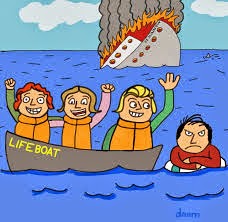
 I don't know how many of you are aware of the insidious simulation called "Lifeboat." In this (and similar scenarios) there are more people on the boat than food to survive. You're given a list of people with "pros" (a scientist) and "cons" (the scientist is also a paraplegic). You must then decide (individually or as a class) who will live and who gets thrown into the ocean to drown. What's the purpose of doing something so hideous? It has nothing to do with critical thinking and everything to do with the evil idea that some people have a fundamental right to choose life or death for others.

 The values clarification movement was developed primarily by philosopher John Dewey, an atheist. Accordingly, behavior should be the result of free, uninfluenced, autonomous choice, based on personal analysis of a given situation coupled with the moment's emotions and desires. Rather than adherence to an external moral code, Dewey pushed something he called "valuation" in which a given situation is explored and various "solutions" discussed. This directly contradicts Church teaching on making choices based on a rightly formed conscience.

 Hence, choices are good or foolish, never right and wrong. Sin and repentance are never mentioned.

Human sexuality programs attempt to inculcate an appreciation for "waiting for marriage" by cultivating fear of bad consequences: pregnancy, disease, and heartbreak. They never state that premarital sex is sinful and they do not urge sinners to repent. Therefore, the dilemma posed to youth by their teachers is no longer a question of morality--- it is a health issue. And, yes, I'm talking about programs in Vatican II schools, not just public schools!

3. Warning to Parents

 A Traditionalist should never send their child to a Vatican II sect school. It's as non-Catholic as sending them to a Yeshiva school (and with lower moral standards). When sending them to public schools, be very aware of everything they are being taught. Ask to see all materials and attend school board meetings. Don't assume that you don't need to inquire about something like an anti-bullying program; it could be a way of inducing acceptance of the sodomite lifestyle. Not to harm homosexuals is one thing, to demand you accept their unnatural practices and so-called "marriages" is another.

 Send your child to a Traditionalist school, if you're lucky enough to have one nearby. Teach them the One True Faith at home, as well as in Traditionalist Sunday school. When they reach middle school age, let them know why so-called "death education" and "values clarification" are wrong. Remind them that the only standards that really matter are God's standards as expressed by the Ten Commandments and the teaching of the Magisterium.

In this way, if they are ever asked to decide who to throw off a lifeboat, they can (correctly) use a Bergoglian saying: "Hey, who am I to judge?"


Monday, February 16, 2015

It's Black And White: There Is No "Pope In Red"


In last week's post, I discussed the so-called "Siri Thesis," the claim by some that Giuseppe Cardinal Siri, not Angelo Cardinal Roncalli, was elected pope at the 1958 conclave to succeed Pope Pius XII.
What troubled me greatly was a website, "thepopeinred.com" which is long on appeals to private revelations and short on citations to approved pre-Vatican II theologians. We are to anticipate "Three Days of Darkness," a chastisement from God revealed to several holy souls (Anna-Maria Taigi, among others), after which Christ will appoint the pope to succeed Siri (who was allegedly "Pope Gregory XVII"). Please beware of anyone who equates or exalts private revelations, even ones approved by the Church (e.g. Fatima), over the Church's Teachings expounded by Her approved pre-Vatican II theologians. No one is bound to accept any private revelation, no matter how many times competent Church authorities approve it. We are bound to accept the teachings of the Magisterium.

  The site links to some even more disturbing sites, especially  "todayscatholicworld.com." and "tcwblog.com."  There they call Abp. Levebvre "non-priest and non-bishop." If true, this would render invalid most Traditionalist priests or bishops who derive their priestly and/or episcopal orders through Abp. Lefebvre. Fortunately, they are wrong, and as Our Lord said, "By their fruits thou shalt know them." (St. Matt. 7:16). Anyone claiming to be of God, and yet would keep people away from the Holy Sacrifice of the Mass and sacraments, can not come from Christ. The so-called "hierarchy in exile"--which seems to consist of one priest, Fr. Peter Kohat Van Tran--- also (for reasons I could not find) consider the orders of Abp. Thuc "dubious."

 Thepopeinred.com and its links bring to surface an old canard that Abp. Lefebvre was neither a priest nor a bishop because his ordaining and consecrating bishop, Archille Cardinal Lienart was a Freemason. The famous Traditionalist writer, Dr. Rama Coomaraswamy, wrote a great article "Cracks in the Masonry," which deals with the issue. However, I believe an even stronger rebuttal is needed at this time.

 1. Was Lienart a Freemason?
 Despite unsubstantiated claims of a "deathbed confession," there is simply no proof Lienart was a Mason. He was a Modernist, to be certain, but claims of "Masonry" go back to one highly dubious source. According to Dr. Coomaraswamy:

"The most specific source is a book entitled Papal Infallibility (L'lnfaillibilité Pontificale) by the French writer Marquis de la Franquerie. This individual is said to be "a papal Secret Chamberlain who lives in Lucon, Vendée, France," and "a learned historian with special knowledge in the field of penetration of the Catholic hierarchy by Freemasonry in France." He is said to be a traditionalist, and a friend of Archbishop Lefebevre.

On page 80 of his book, during the course of a discussion of the modernist maneuverings in prepraration for Vatican II, the Marquis mentions, almost in passing, that Cardinal Liénart was a “luciferian” who attended "black Masses." Toward the end of a lengthy footnote on another topic that continues onto the following page, the Marquis adds:“This attitude of the Cardinal could not sur­prise those who knew his membership in the Freemasonic and Luciferian lodges. This was the reason why the author of this study [i.e., the Marquis de la Franquerie] always had refused to accompany Cardinal Liénart in the official ceremonies as Secret Chamberlain.
      “The Cardinal had been initiated in a lodge in Cambrai whose Venerable was Brother Debierre. He frequented a lodge in Cambrai, three at Lille, one in Valenciennes, and two in Paris, of which one was in a special way com­posed of parliamentarians. In the year 1919, he is designated as ‘Visitor’ (18th Degree), then, in 1924, as 30th degree. The future Car­dinal met in the lodges Brother Debierre and Roger Solengro. Debierre was one of the in­formers of Cardinal Gasparri who had been initiated in America, and of Cardinal Hartmann. Archbishop of Cologne, a Rosicrucian.
      “The Cardinal belonged to the International League against Anti-Semitism, where he met up again with Marc Sangnier and Father Violet.“It was given to us to meet in Lourdes a former Freemason who, on July 19, 1932, had been miraculously cured of a wound suppurating on his left foot for fourteen years — a cure recognized by the Verification Bureau on July 18, 1933. This miraculously-healed gentleman, Mr. B..., told us that, at the time when he frequented a Luciferian lodge, he met there the cardinal whom he recognized and was dumbfounded.”
      Another source cited is Archbishop Lefebvre himself. In a talk given in Montreal, Canada on May 27, 1976, he stated:“Two months ago in Rome, the traditionalist periodical Chiesa Viva, published — I have seen it in Rome with my own eyes — on the back side of the cover, the photograph of Cardinal Liénart with all his Masonic paraphernalia, the day of the date of his in­scription in Masonry..., then the date at which he rose to the 20th, then to the 30th degree of Masonry, attached to this lodge, to that lodge, at this place, at that place. Mean­while, about two or three months after this publication was made, I heard nothing about any reaction, or any contradiction. Now, un­fortunately, I must say to you that this Cardinal Liénart is my bishop, it is he who or­dained me a priest, it is he who consecrated me a bishop. I cannot help it... Fortunately, the orders are valid... But, in spite of it, it was very painful for me to be informed of it.”
      The issue of Chiesa Viva was No. 51, March, 1976. In it there is an article entitled "Il Cardinale Achille Liénart era Massone."
However, the Archbishop's memory was faulty, for the photograph involved was a picture of Cardinal Liénart in ordinary ecclesiastical attire, and below this a drawing which shows a monumental entrance door to a building around which Freemasonic sym­bols are grouped. This second picture carried the designation: "Entrance door to a Freemasonic temple."
The article, whose author is not named, says that the source of his information is pages 80 and 81 of Papal Infalibility, the book quoted above. Another Italian journal, Si Si, No, No, also informs us that Cardinal Liénart was a Freemason. Its source, however, also turns out to be the Marquis de la Franquerie’s Papal Infalibility. Now, gentle reader, this is the sum total of the "evidence" brought forth for Cardinal Liénart be­ing a Freemason! And it all goes back to the asser­tions of the Marquis de la Franquerie......The Marquis provides a similar paucity of evidence — a "Mr. B..." who knew of this matter in 1932, but, despite his gratitude to the Blessed Virgin for a miraculous cure, and despite the fact that he knew Achille Liénart was teaching in the Seminary of Lille, ordaining priests and con­secrating bishops, decided not to share his precious secret. Nothing like an "irrefutable anonymous source”!......Now, I find it extremely strange that the Marquis, who received this high papal honor of being named a Secret Chamberlain, did nothing to expose this terrible situation when he had access to Church authorities prior to Vatican II. Why did he also wait until the mid-seventies to provide the world with this informa­tion? It seems, then, that we cannot really take any of the evidence seriously. It is sensationalist tittle-tattle that proves nothing.
We are therefore morally obliged to find the "defendant," Cardinal Liénart, not guilty of the charge."

2. What if Lienart HAD been a Mason? Does this fact render the ability to receive and confect sacraments invalid or dubious?

No. The websites contend that (a) Masons are heretics and their elevation as bishops are rendered null and void by Ex Cum Apostalatus of Pope Paul IV, and (b) Masonic membership equals invalid sacraments because they withhold their intention to receive and confect sacraments. The website states:
 Ex Cum Apostalatus says, "...if at ANY TIME it will be found (discovered) that some bishop, BEFORE his promotion or assumption had deviated from the Catholic Faith or fallen into some heresy (i.e. Occult Freemasonry), ...that promotion or assumption ("consecration") concerning him... is null, void and worthless (FOREVER) ... and ... [no] length of whatever time in the future, can be said to have recovered power or to be able to recover power, nor can (the assumption or promotion) ["consecration"] be considered as legitimate in any part of it, ... for those who are promoted (FALSELY/INVALIDLY) as bishops... ."

This means that they would have no JURISDICTIONAL authority, not an absence of  sacramental power as valid bishops. Since the papacy is only an office of jurisdiction, and not a sacrament, a heretic can never be a valid pope. As to point (b), here's what canonists and the pre-Vatican II theologians have taught:

Principle: Sacraments conferred by a Catholic minister, including Holy Orders, must be presumed valid until invalidity is proved.

"When the fact of ordination is duly established, the validity of the orders conferred is naturally to be presumed." (W. Doheny, Canonical Procedure in Matrimonial Cases [Milwaukee: Bruce 1942] 2:72.)


"Now, if a person has seriously and duly used the proper matter and form for performing or administering a sacrament, he is by that very fact presumed to have intended to do what the Church does." (Bull Apostolicae Curae, 13 September 1896.)The theologian Leeming says this passage recapitulates the teachings of previous theologians who "all agreed that the outward decorous performance of the rites sets up a presumption that the right intention exists.… The minister of a sacrament is presumed to intend what the rite means… This principle is affirmed as certain theological doctrine, taught by the Church, to deny which would be at least theologically rash." (B. Leeming, Principles of Sacramental Theology [Westminster MD: Newman 1956], 476, 482.)

4. Does heresy, or even apostasy, nullify an ordaining/consecrating bishop's intention?

No.

"Error in faith, or even total disbelief, does not harm this intention; for concepts of the intellect have nothing in common with an act of the will." (S. Many, Praelectiones de Sacra Ordinatione [Paris: Letouzey 1905], 586.)

5.  What would be necessary to have a "defect of intention"?

"An ordination is invalid if the minister… as he confers it on someone, makes an act of the will not to ordain that person, because by that very fact he does not have at least the intention of doing what the Church does —indeed, he has a contrary intention." (P. Gasparri, Tractatus de Sacra Ordinatione [Paris: Delhomme 1893], 1:970.)

6.  Is a bishop, even one who belongs to Masonry, presumed to have such a "contrary positive intention"?


No.

"In performing an ordination the minister is never presumed to have such an intention of not ordaining, as long as the contrary would not be proved. For no one is presumed evil unless he is proven as such, and an act — especially one as solemn as an ordination — must be regarded as valid, as long as invalidity would not be clearly demonstrated." (Gasparri, 1:970.)

However, thepopeinred.com would have us set up a presumption opposite of what the Church teaches. "Masonic" prelates are, according to the popeinred.com, to be presumed guilty until proven innocent! The runs contrary to the principles of equity taught by both ecclesiastical law and U.S. civil law.

7.  Do the Siri theorists at tcwblog.com (and the related links) cite to any pre-Vatican II theologians, or canonists to prove their contention that a Masonic bishop confers invalid or dubious sacraments?

No.

They cite no pre-Vatican II canonist, moral theologian or dogmatic theologian who proposes or defends their contention about Masonic membership and invalid/dubious sacraments.


Instead, all they offer are the standard quotes about Masonry — it conspires to destroy the Church, is condemned by popes, promotes Naturalism, is a cause for excommunication, etc. This merely proves what no one disputes: Masonry is evil.


However, wicked men and even unbelievers can confer valid sacraments, so it gets you no closer to proving the principle they have invented: "Masonic membership results in producing invalid/doubtful sacraments."


If such a general principle were true, popes, canonists and theologians would have told us so, and these websites would be able provide quotes and citations.

8. What are the logical--and ridiculous--conclusions of the invented principles of these websites?


During the French Revolution, you have a notorious Mason, Bishop Talleyrand, consecrating as a Bishop for the so-called "Constitutional Church" Bishop Jean-Baptiste Suarine. Bp. Saurine belonged to the Grand Orient Masonic Lodge of Paris. Of all the Masonic lodges in the world, the Grand Orient of Paris in which Saurine was a governing member has always been considered the most powerful and the most anti-Catholic. Despite this, Pope Pius VII appointed Mgr. Saurine Bishop of Strasbourg in 1802, a post that this Masonic bishop retained until his death in 1813.


So in France we find Masonic bishops consecrating other Masons bishops, whom the pope then appoints to head Catholic dioceses, where they confirm children, bless holy oils used to anoint the dying, ordain priests and consecrate other bishops. Yet, the Church NEVER considered such consecrations invalid (in either conferral or reception) on the basis of Masonic membership--and in this case, unlike Lienart, it is a proven fact! Consider also that much of the lower clergy were Masons.

"One fact is inescapable: the lodges contained a large number of ecclesiastics… At Caudebec fifteen out of eighty members of the lodge were priests; at Sens, twenty-five out of fifty. Canons and parish priests sat in the Venerable Assembly, while the Cistercians of Clairvaux had a Lodge within the very walls of their monastery! Saurine, a future bishop of Strasbourg under Napoleon, was a governing member of the Grand Orient. We cannot be far from the truth in suggesting that towards the year 1789 a quarter of French freemasons were churchmen… [In 1789 there were] seven atheists and three deists out of one hundred and thirty-five French bishops." (H. Daniel-Rops, The Church in the Eighteenth Century [London: Dent 1960] 63, 73. See also J. McManners, Church and Society in Eighteenth-Century France [Oxford: University Press 1998] 1:354, 356, 420, 509.)
What about all the baptisms given by Masonic priests? They would be considered invalid, which would in turn render invalid all the ordinations of any boys who grew up to be priests (you need to be baptized to be ordained). Any of these invalid priests who might have been consecrated bishops would also be invalid bishops. There's no end to the lunacy.

Would God permit a "hierarchy in exile" to teach such manifest nonsense? There is no incontrovertible proof that Siri was pope, and no proof he appointed a successor or has a "hierarchy." Forget the "pope in red." Worry about the "phony in white" at the Modernist Vatican.


Monday, February 9, 2015

One Question Siri Can't Answer


 In this day and age of modern technology, Siri is an application for Apple's iOS which works as a personal assistant and knowledge navigator. Ask a question, and Siri will answer in English with a female voice. Ask it "Who was elected pope in 1958?" and it will respond by mentioning an enigma in Traditionalist circles--the "Siri Theory." This theory proclaims as fact that in the 1958 conclave to succeed Pope Pius XII, it was actually Giuseppe Cardinal Siri who was elected as Pope Gregory XVII, but was forced under grave duress to step aside for Angelo Roncalli (John XXIII).  What significance does this theory hold for Traditionalists? What are the practical consequences? It is these questions I will now explore.

1. What evidence is there that Siri was elected pope and not Roncalli?

On October 26, 1958, white smoke appeared from the conclave to succeed Pope Pius XII signaling the election of a new Vicar of Christ. Black smoke came out about two hours later, and the white smoke was claimed to be a mistake. On October 28, 1958, Antipope John XXIII was declared the new pontiff. It is claimed that Cardinal Siri, of Genoa, had been elected and taken the name of Pope Gregory XVII. Siri, a staunch anti-Communist and anti-Modernist was (according to proponents of the theory) blackmailed into stepping aside. Some say it was threats against his life and his family, others say it was threats from Communist Russia that they would launch nuclear missiles at Rome. There is also a credible report from one FBI source that suggests Siri was elected. (See The Vatican Exposed: Money, Murder, and the Mafia by Paul L. Williams, 2003, Prometheus Books).

 Canon 185 of the 1917 Code of Canon Law states, "Resignation is invalid by law if it was made out of grave fear unjustly inflicted, fraud, substantial error, or simony."  Had such an occurrence taken place, Siri would have indeed remained pope, and Roncalli an antipope. My spiritual father, Fr. Gommar A. DePauw, JCD, was a peritus (expert) at Vatican II and fought against the Modernists. He told me, based on his personal knowledge of many Cardinals who were involved in the 1958 conclave, that the real fight was between Cardinals Ottaviani and Siri. Ottaviani was so confident of his election, he had already picked out his papal name---Pius XIII. When he and Siri locked for votes and neither could muster 2/3 plus one for election, a small band of Cardinals came up with a plan for a "transitional" pope---and Roncalli was elected. The white smoke could have been an error, and there is evidence for this as well. The explanation by Fr. DePauw and human error could account for the white smoke.

 2.  If Siri had been elected Pope, would he have remained such until his death in 1989?

 Siri certainly didn't act like a pope. He signed all of the documents at Vatican II, especially Lumen Gentium, the damnable document with the heretical ecclesiology of "Frankenchurch" i.e., that there is an entity known as the "Church of Christ" that is distinct from the Roman Catholic Church, but resides there in its "fullness." This Church of Christ resides elsewhere according to how many "elements" the sect possesses. To have all the elements like the RC Church is best, but to have some is good as well and leads to salvation. This trashes the necessity of Church membership for salvation, and allows for Francis to maintain "Proselytism is nonsense."

Siri also said the Novus Bogus invalid Vatican II bread and wine service, never supported any Traditionalist group (sedevacantist or SSPX), and publicly recognized Rocalli (John 23), Montini (Paul 6), Luciani (JP I) and Wotyla (JP II) as "popes."  He used the invalid Vatican II "sacraments," and gave the "homily" at the "mass" of Christian Burial for John Paul I (Luciani). Of course, we can always concoct boogeymen to say he was "coerced" into all of this for over 30 years. You know; Masonic death threats, Communist threats of nuclear war, etc. But how credible does all this sound? Couldn't he have at least done as much as Bishop Antonio de Castro Mayer of Campos, Brazil and refuse to use the new "mass" and "sacraments" in his diocese? Despite claims by some that he did this, it is unsubstantiated. The fact that he used the new "mass" and "sacraments" is incontrovertible. Seeing the Vatican II sect in the 1980s, he couldn't call a press conference before his death? (On that score, supporters will claim that he was held to silence in the conclave by a seal not unlike confession).

Had he been elected, it seems that he would have lost his office by becoming a heretic, unless you posit that he was under constant grave duress for over 30 years!

3. Where is the pope now? Did Siri leave a successor?

 If Siri was pope, and if he didn't lose office through heresy (both very big IFs), did he appoint a successor? There is no indication that such was ever even attempted by Siri. There is a website thepopeinred.com, LOADED with error in many things, which claims that Siri's successor will be revealed after "Three Days of Darkness." As usual in all things claiming to be Catholic but are bizarre, private revelations are exalted above the teachings of the pre-Vatican II theologians. It's always about visions, apparitions, etc. When theology is even attempted, its restricted to St. Thomas Aquinas, as if theology stopped with him. I will have more to say regarding "thepopeinred.com" next week. I would be remiss if I didn't say there exists a small group which holds that Siri, before his death, had appointed a "Pope Gregory XVIII" who (for some reason or other) is "in hiding." They are called "sedeimpedists" since the pope is impeded from claiming the Chair of Peter, distinguishing them from "conclavists" who "elected" an antipope (e.g. "Pope" Michael).

4. What does the "Siri Theory" have to do with Traditionalists in the practical order?

 Nothing. If he were the pope (at least during the conclave and before the signing of the Vatican II documents) this would make John XXII an Antipope--as well as Montini (Paul VI). However, we already know that these two papal claimants could not be popes on wholly separate and independent grounds. Ditto for JP I and JP II, had he somehow retained his office until his death in 1989. We are still in a state of sedevacante, and the Vatican II sect must be opposed. A "secret successor'? I'll deal with that one next week--there isn't any.

Who was elected in 1958? Only Siri (Giuseppe) can answer that one for certain, and having passed into eternity May 2, 1989, he won't be answering.