Monday, March 14, 2022

Baptismus Flaminis


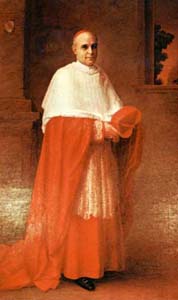
To My Readers: One of my readers sent me this article he wrote combating Feeneyism. As any regular visitor of my blog knows, I have written many times against this pernicious heresy. Nevertheless, this individual noted that he sees a spike in those professing the errors of the excommunicated priest, Leonard Feeney, to one degree or another. His article is concise and clearly written, and I have decided to use it as a post. The author wishes to remain anonymous, and he shall be credited simply as An Anonymous Traditionalist. For the picture accompanying this week's post, I have chosen the great Saint and Doctor of the Church, St. Alphonsus Liguori, considered by the majority of theologians to have been the most erudite champion of the Faith, second only to St. Thomas Aquinas. 

St. Alphonsus did a magnificent job explaining the decrees of Trent and the Church's teaching on Baptism of Desire (BOD) and Baptism of Blood (BOB). I hope you enjoy this refresher on a matter of Church doctrine. It also gives me a needed break, especially with my expanding work duties, and in a week when I'm losing a precious hour to Daylight Savings Time. Please feel free to comment as usual, and I will be responding. 

God Bless you all, my dear readers---Introibo

Baptismus Flaminis
By An Anonymous Traditionalist
Written in honor of St. Alphonsus de Liguori and St. Thomas Aquinas on the Feast Day of St. Agatha, Virgin and Martyr, 4th of February 2022 AD. I, an anonymous author who is una cum sede apostolica, offer the following writing, submitted to the future decisions of the Magisterium of the Holy Roman Catholic Church, for the salvation of souls and the destruction of heresy.---An Anonymous Traditionalist. 

The Baptism of Desire, simply put, is the perfect act of contrition or charity of the unbaptized that receive the theological virtue of faith; which is received by hearing the faith preached by a preacher sent from God or by receiving the virtue of faith by an internal inspiration of grace from God. When the unbaptized make this perfect act of contrition or charity, united with the supernatural virtue of faith, they are (by definition) in the state of sanctifying grace. If the unbaptized dies in this state, then it follows that they go to Heaven, or in the case of those souls that need to still expiate their sins, Purgatory.

St. Thomas Aquinas, De Veritate, 14, A. 11, ad 1: Objection- “1. Granted that everyone is bound to believe something explicitly, no untenable conclusion follows even if someone is brought up in the forest or among wild beasts. For it pertains to divine providence to furnish everyone with what is necessary for salvation, provided that on his part there is no hindrance. Thus, if someone so brought up followed the direction of natural reason in seeking good and avoiding evil, we must most certainly hold that God would either reveal to him through internal inspiration what had to be believed or would send some preacher of the faith to him as he sent Peter to Cornelius (Acts 10:20).” (Emphasis added).

The controversy surrounding Baptism of Desire begins with a certain Leonard Feeney. He was ordained a priest, as a Jesuit, on June 20, 1928. He became a professor at Boston College, and then became the chaplain of the Saint Benedict Center in 1945. Soon after his appointment, he preached against the doctrines of the Baptism of Desire and Baptism of Blood. His Jesuit superiors ordered him to leave the Center for a post at the College of the Holy Cross, but after initially going there, he returned to the Center and repeatedly refused to comply with the ecclesiastical order. Feeney was summoned to Rome to answer for his teachings, but he refused to go. By 1949 he was building an illicit religious order filled with married folk without canonical approval. On February 13, 1953, Feeney was solemnly excommunicated by His Holiness, Pope Pius XII. In 1972, Feeney reconciled with the post-Vatican II hierarchy without recanting his errors. Tragically, Leonard Feeney’s story of error ends with his death in the year 1978, AD, externally in union with the Modernist hierarchy. (N. B. Although a valid priest, once he was solemnly excommunicated by the Holy Father, Leonard Feeney forfeited his right to be known by his ecclesiastical title of “Father.” Hence, we do not speak of “Fr. Martin Luther.” ---Introibo).

While it is true that Leonard Feeney saw the Modernist theological attempts to use Baptism of Desire in a heretical manner, that manner being a sort of universalism, this foresight does not give one the liberty to deny Catholic doctrine. This denial of Catholic doctrine affects Traditionalists in America to the current day, and those influenced by the global impact of American culture.

At the time of writing this (the year being 2022 AD), a man claiming to be a bishop, Neal Webster, along with his clergy, an illicit so-called Benedictine Monastery called Most Holy Family Monastery, the St. Benedict Center of New Hampshire, a certain Charles Coulombe of Tumblar House (author of Desire & Deception), and Loreto Publications, all to some degree hold to the position of Feeney, which is the condemnation of the Baptism of Desire and Baptism of Blood.

Due to these facts of Feeney’s life, and the fact of his enduring legacy found amongst heretical offspring, may God have mercy on Leonard Feeney’s eternal soul. Today, the heresy of Feeney, the rejection of the perfect act of charity or contrition for the unbaptized, must be refuted because it is a pernicious, mortally sinful heresy that attacks the authority of the Catholic Church; the substance of this error condemns the very salvation of those souls united to the soul of the Holy Roman Catholic Church (1) , outside of which there is no salvation.

Every heresy, to some degree, attacks the Catholic religion in Her doctrines, disciplines, and liturgy. The Protestants, for instance, reject Catholic dogmas (notably the dogma of papal authority), Catholic disciplines (as a general rule, they do not keep laws of fast or abstinence), and Catholic liturgy (Protestant “reformers” created false liturgies stripped of Catholic prayers). As another example, the Modernists of Vatican II reject Catholic dogmas (the false religious liberty of Dignitatis Humanae contradicts the Magisterium in Quanta Cura which condemns religious liberty), Catholic disciplines (the 1983 Code of Canon law allows the mortally sinful practice of praying in common with heretics and schismatics), and Catholic liturgy (the new “mass” substantially differs from the Traditional Latin Mass to have a spirit comfortable to the most liberal of Protestants). The heresy of Feeneyism, more precisely the position of Most Holy Family Monastery (the rejection of Baptism of Desire and Baptism of Blood), shares in this same attack against the doctrines, disciplines, and liturgy of the Holy Roman Catholic Church, which this Church is habitually assisted by the Holy Ghost for the salvation of souls.

Thus, how the heresy of Feeneyism attacks the Catholic religion is to be defined.

Decidedly, Feeneyism rejects the Catholic doctrine of Baptism of Desire (the perfect act of contrition or charity). The Feeneyites base this rejection on their interpretation of the Magisterium. They quote directly the various magisterial statements on the necessity of sacramental baptism to justify their position. However, such quotations lack the official interpretation given by the ordinary teaching authority of the Church (in other words, the Magisterium). A Feeneyite could send these quotations all day, but if it lacks the official interpretation of the Church, then such quotations are all for naught.

 The correct means to understand theological quotations correctly requires one to consult the writings of approved Church theologians. It should be noted that they, approved theologians, do not officially and authoritatively teach doctrine, unless their voices are raised in a universal and ordinary manner on matters pertaining to faith or morals (2); but rather show where the Church teaches doctrine from the official interpretation of the Magisterium. 

The Feeneyites have yet to quote a single theologian, with the requisite credibility, that has adequately shown where the Church has officially condemned Baptism of Desire or Blood as heretical. Such a condemnation does not exist because the Universal and Ordinary Magisterium has consistently taught Baptism of Desire down through the centuries, and the Council of Trent infallibly taught it as well. Many quotes can prove this point, (such as from St. Hippolytus of the 3rd century or St. Prosper of Aquitaine of the 5th century), but previous works have already proven this point.

Indeed, the followers of Feeney attack the universal disciplines, which are attached to the universal liturgy of the Church, of the Roman Church. This rejection involves denying the passive infallibility of the 1917 Code of Canon Law because the Code expresses Baptism of Desire within certain canons. The logical conclusion of rejecting the canons, that support Baptism of Desire, necessarily implies that the public worship of the Requiem Mass offered for unbaptized catechumens is evil and condones heresy, yet the Church cannot give that which is evil to Her members. Furthermore, the Dimond Brothers and/or those clergy under Neal Webster, because they would have to logically condemn and censure the “heretical practice” of offering such Requiem Masses believe that the Church can sanction evil.

 Another absurdity, that absurdity which brings the dear reader to a main theme of this post, must be exposed, that is, if it is not infallible, then it can be heretical. The Dimond Brothers are notorious for doing just this, their literature is filled with objections being answered with “such a document is not infallible.” By doing this, they aim for the trees but end up destroying the whole forest. When one, whether they be of the Dimond Brothers or of the Gallican SSPX variety, or of Neal Webster’s clergy, says that the Church, in her official disciplines/liturgy, can give poison, pernicious error that sends souls to Hell; such a one implies that the Roman Catholic Church has defected, (the forest, being the Church, is destroyed). Every false religion defects, that is, a religion which is a means of damnation, in their doctrines, disciplines, and liturgy. The Roman Church is set apart from other religions, because it cannot defect; therefore the Catholic Church has not taught, ruled, or sanctified, a pernicious error when on the subject of the Baptism of Desire down through the centuries, because the Baptism of Desire is taught, ruled, and sanctified by the Church's teaching authority (3) 

The heresy of Feeneyism is to be rejected because it logically argues, in its conclusions, that the Catholic Religion has defected in Her doctrines, disciplines and liturgy down through the centuries. Furthermore, it is absurd to believe that the Doctors, theologians, Popes, and Church Fathers, of the Holy Roman Faith, have all failed to timely condemn, through the use of the Universal and Ordinary Magisterium, the “pernicious error” of Baptism of Desire and Baptism of Blood. May the heretical children of Leonard Feeney, who follow these absurdities, be converted back to the One True Church through the intercession of the Blessed Virgin Mary, the Mother of God.

Our Lady, Destroyer of Heresies, pray for us.

Endnotes and Addendum

1.      New Catholic Dictionary, Soul of the Church definition (1929): "From the 16th century, the Catholic theologians expressed more definitely the theological doctrine of the distinction between the Soul and Body of the Church. . . This distinction. . . is formally expressed by Bellarmine in his study on the members of the Church. According to him, men belong to the Body of the Church by virtue of external profession of the faith, and participation in the sacraments, and to the Soul of the Church through the internal gifts of the Holy Ghost, faith, hope, and charity. He draws three general conclusions relative to the members of the Church. There are those: (a) Who belong always to both the Body and Soul of the Church; (b) Who belong to the Soul without belonging to the Body; (c) Who belong to the Body but not to the Soul. This teaching has generally been followed by Catholic theologians.”

2.     A Commentary on Canon Law, (Augustine, 1918, Canon 1323, pg 327) states: "The universal and ordinary magisterium consists of the entire episcopate, according to the constitution and order defined by Christ, i.e., all the bishops of the universal Church, dependently on the Roman Pontiff". It also states, "What the universal and approved practice and discipline proposes as connected with faith and morals must be believed. And what the Holy Fathers and the theologians hold unanimously as a matter of faith and morals, is also de fide."

3.     Pope Pius XII, Address to the Midwives, official allocution of the Roman Pontiff: “An act of love is sufficient for the adult to obtain sanctifying grace and to supply the lack of baptism; to the still unborn or newly born this way is not open.”

COUNCIL OF TRENT (1545-1563) Canons on the Sacraments in General (Canon 4): “If anyone shall say that the sacraments of the New Law are not necessary for salvation, but are superfluous, and that although all are not necessary for every individual, without them or without the desire of them (sine eis aut eorum voto), through faith alone men obtain from God the grace of justification; let him be anathema.” (Emphasis added).

Decree on Justification (Session 6, Chapter 4): “In these words a description of the justification of a sinner is given as being a translation from that state in which man is born a child of the first Adam to the state of grace and of the ‘adoption of the Sons’ (Rom. 8:15) of God through the second Adam, Jesus Christ, our Savior and this translation after the promulgation of the Gospel cannot be effected except through the layer of regeneration or a desire for it, (sine lavacro regenerationis aut eius voto) as it is written: ‘Unless a man be born again of water and the Holy Spirit, he cannot enter in the kingdom of God’ (John 3:5).” (Emphasis added). 

 ST. ALPHONSUS LIGUORI (1691-1787) Moral Theology (Bk. 6): “But baptism of desire is perfect conversion to God by contrition or love of God above all things accompanied by an explicit or implicit desire for true Baptism of water, the place of which it takes as to the remission of guilt, but not as to the impression of the [baptismal] character or as to the removal of all debt of punishment. It is called “of wind [flaminis] because it takes place by the impulse of the Holy Ghost Who is called a wind [flamen]. Now it is de fide that men are also saved by Baptism of Desire, by virtue of the Canon Apostolicam De Presbytero Non Baptizato and the Council of Trent, Session 6, Chapter 4, where it is said that no one can be saved “without the laver of regeneration or the desire for it.” (Emphasis added).

 1917 CODE OF CANON LAW Canon 737: “Baptism, the door and foundation of the Sacraments, in fact or at least in desire necessary unto salvation for all, is not validly conferred except through the ablution of true and natural water with the prescribed form of words.” (Emphasis added)

On Ecclesiastical Burial (Canon 1239. 2) “Catechumens who, through no fault of their own, die without Baptism, are to be treated as baptized.” — The Sacred Canons by Rev. John A. Abbo. St.T.L., J.C.D., and Rev. Jerome D. Hannan, A.M., LL.B., S.T.D., J.C.D. Commentary on the Code: “The reason for this rule is that they are justly supposed to have met death united to Christ through Baptism of Desire.”(Emphasis added). 


Monday, March 7, 2022

Contending For The Faith


In St. Jude 1:3, we read, "Dearly beloved, taking all care to write unto you concerning your common salvation, I was under a necessity to write unto you: to beseech you to contend earnestly for the faith once delivered to the saints." [Emphasis mine]. Contending For The Faith is a series of posts dedicated to apologetics (i.e.,  the intellectual defense of the truth of the Traditional Catholic Faith) to be published the first Monday of each month. 

Sadly, in this time of Great Apostasy, the faith is under attack like never before, and many Traditionalists don't know their faith well enough to defend it. Remember the words of our first pope, "But in your hearts revere Christ as Lord. Always be prepared to give an answer to everyone who asks you to give the reason for the hope that you have. But do this with gentleness and respect..." (1Peter 3:16). There are five (5) categories of attacks that will be dealt with in these posts. Attacks against:
  • The existence and attributes of God
  • The truth of the One True Church established by Christ for the salvation of all 
  • The truth of a particular dogma or doctrine of the Church
  • The truth of Catholic moral teaching
  • The truth of the sedevacantist position as the only Catholic solution to what has happened since Vatican II 
In addition, controversial topics touching on the Faith will sometimes be featured, so that the problem and possible solutions may be better understood. If anyone had suggestions for topics that would fall into any of these categories, you may post them in the comments. I cannot guarantee a post on each one, but each will be carefully considered. This first post will explain the necessity of being able to prove with reason the existence of God and the supernatural and why this series is necessary.  All subsequent posts will begin with a precise topic. (The information on scientism in this post comes from many sources, not the least of which are various essays in Scientism: The New Orthodoxy, ed. Richard M. Williams and Daniel N. Robinson [2015], among others. I give full credit to these sources and take no credit---Introibo). 

Modernism, Scientism, and the Supernatural

A few years ago, I was eating lunch at my desk and re-reading the Catholic classic The Spiritual Combat, by Fr. Scupoli. A colleague of mine was walking past me and saw the book. He stopped and asked, "That's the kind of reading you do outside of work?" Without hesitation, I responded, "Yes." He looked perplexed and inquired, "Weren't you a former science teacher with an advanced degree in science?" "That's correct," I replied. As he turned to walk away, I asked if this is what he was thinking:

I started off in science, which deals with reality—hard facts—and conclusions that could be proved to be true. However, theology was a field in which there were only private opinions or personal feelings, where no one was right or wrong, or if they were, no one could know who was right. Science was cognitive, and theology was personal and emotional. He stared at me dumbfounded, as if I had read his mind, and nodded in the affirmative. My colleague was expressing the view called scientism. Since scientism is so pervasive today—it is the intellectual and cultural air that we breathe—he could not have even named the worldview he was presupposing and articulating. Before I explain scientism, I must explain its origin in Modernism. 

Modernism is an amalgamation of errors. It begins with agnosticism.  According to this teaching, human reason is confined entirely within the field of phenomena, which means things that appear to the senses, and it has no power to overstep these limits. Since we cannot know (or even infer) to the existence of things outside the scope of phenomena, the human intellect is incapable of knowing the existence of God. As a result, Modernism denies the supernatural as an object of certain knowledge. 

God is something which comes forth from man's subconscious. Religion is therefore essentially about feelings, specifically what makes you feel good; if Christianity, or any other religion, is what makes you feel good and more in touch with the Divine, then it is true for you. Religion has never consisted of creeds or objective truth but of feelings. This doctrine is known as vital immanence.

With the advance of science beginning in the mid-1800s, which combined with the tenets of Modernism, scientism was spawned. Roughly, scientism is the view that the hard sciences—like chemistry, biology, physics, astronomy—provide the only genuine knowledge of reality. At the very least, this scientific knowledge is vastly superior to what we can know from any other discipline. Ethics and religion may be acceptable, but only if they are understood to be inherently subjective and regarded as private matters of opinion. According to scientism, the claim that ethical and religious conclusions can be just as factual as science, and therefore ought to be affirmed like scientific truths, may be a sign of bigotry and intolerance.

According to philosopher of science Tom Sorell, “Scientism is the belief that science, especially natural science, is . . . the most valuable part of human learning . . . because it is much the most [sic] authoritative, or serious, or beneficial. Other beliefs related to this one may also be regarded as scientistic, e.g., the belief that science is the only valuable part of human learning. . . .” (See Tom Sorell, Scientism: Philosophy and the Infatuation with Science [1991], pg.1). Sorell notes that “What is crucial to scientism is not the identification of something as scientific or unscientific but the thought that the scientific is much more valuable than the non-scientific, or the thought that the non-scientific is of negligible value.”(Ibid, pg.9). In other words, when you have competing knowledge claims from different sources, the scientific will always trump the nonscientific.

There are two types of scientism; strong and weak. Strong scientism implies that something is true, rationally justified, or known if and only if it is a scientific claim that has been successfully tested and that is being used according to appropriate scientific methodology. There are no truths that can be known apart from appropriately certified scientific claims, especially those in the hard or natural sciences. Lawrence Principe correctly notes that, when it comes to strong scientism, the central idea is that “science and its methods provide the only fully valid route to gaining knowledge and for answering questions, to the exclusion of other methods and disciplines.” (See Lawrence Principe, “Scientism and the Religion of Science,” in Scientism: The New Orthodoxy, ed. Richard M. Williams and Daniel N. Robinson [2015] pg. 42). 

Weak scientism is still scientism, but it allows for more “wiggle room.” Weak scientism acknowledges truths apart from science, granting them some minimal rational status even if they don’t have scientific support. Nevertheless, weak scientism still implies that science is by far the most authoritative sector of human knowing. For practical purposes, weak scientism amounts to pretty much the same thing as strong scientism, though, technically speaking, they do differ. As noted above, weak scientism does not say that the sciences—especially the hard sciences—are the only way available to us to achieve knowledge of truth about reality; rather, advocates of weak scientism are willing to grant minimal rational status to at least some disciplines that most would not classify as scientific fields, such as philosophy.

The Impact on the Church
Both strong and weak scientism have had a profound impact on the faith. 

 1. Scientism Puts The Claims of the Church Outside of the "Plausibility Structure." To the extent that scientism is embraced in our culture, our moral and spiritual claims will be “de-cognitivized.” In other words, our deepest beliefs about life, knowledge, history, and reality will seem to be utterly implausible—not just untrue, but unworthy of rational consideration.

2. Scientism Has Brought About Several Shifts That Now Define Our Culture.
The first shift is in the realm of religion and ethics and is a shift from knowledge to blind faith. Shortly after the Mohammedan terrorist attack on September 11, 2001, New Age occultist Oprah Winfrey focused an episode of her program on the turn to God since the attack, a turn she herself wished to foster. For those already deadened to cultural shifts, the program was fairly uneventful, but for those with eyes to see, it was breathtaking. To explain, let me note first what Oprah did not do. She did not get on the air, warn that we were under threat of a terrorist smallpox attack, and urge people to seek protection from smallpox, whatever such protection meant to each individual: If your truth implies that smallpox prevention comes by eating cereal and not eggs for breakfast, then go for it. If it implies that you should attend more movies to relax your immune system, then live out your truth in this way. 

We shouldn’t get hung up on the word we use for “smallpox prevention”—cereal, movie attendance, or whatever—the important thing is to seek prevention, whatever that means to you. Indeed, Oprah would not even presume to speak about smallpox prevention, since she is not an expert in medicine. Rather, she would bring a doctor on the show to address such an issue. This is because she, like all of us, would assume that the issue of smallpox prevention is one of objective fact, that there is a body of knowledge relevant to the issue, and that some people—experts—have the knowledge needed to address the problem.

However, this is how Oprah did respond to 9/11: She urged people to seek God, “whatever he, she, it, or they mean to you.” We should not get hung up in the word we use for him, her, it, or them, she cautioned. The important thing is that we all seek our own truth with renewed vigor. Now, what assumptions—most likely subconscious—must Oprah Winfrey and her editorial crew be making about religion and the audience’s understanding of it? The assumption is that, in contrast to scientific assertions, religious claims are neither factual in nature nor subject to rational evaluation. Religion is not a domain of fact and knowledge, so there are no experts (approved theologians) on that subject. Thus, a talk show host’s feelings about her own truth regarding religious matters is no more “valid” than anyone else’s.

 The second shift is in the realm of guidance for living one’s life, and it goes from truth to the immediate satisfaction of desire. Look at the Vatican II sect. The Novus Bogus is a "Happy Meal" where we sing songs, shake hands, and feel good about ourselves. Bergoglio's focus is on the world, environmentalism, youth unemployment, the loneliness of the elderly, etc. The supernatural goal of avoiding Hell and gaining Heaven is outdated and never mentioned seriously.  

 The third shift is from obedience to the Ten Commandments to "minimalist ethics," or "One may morally act in any way one chooses so long as one does not do harm to others." I could retire a multimillionaire if I had a dime for every time someone asked me, "Why are you opposed to same-sex marriage (sic)? They're not hurting anybody." This makes it difficult to justify resistance to a wide range of immoral practices, such as pedophilia. If this is what adults want to do to satisfy their desires,-- "Who am I to judge?" The standard response to this is that pedophilia is wrong because children cannot give consent to sex with an adult.

However, absent moral knowledge, who can say that consent is a morally relevant notion? Also, we don’t get consent to give children only healthy foods they don't necessarily like, and we force them to go to school, because these things are good for children. Believe it or not, some contemporary groups are arguing that the idea that sex with adults harms children is an outdated, "Victorian Christian idea" and, in fact, sex with adults is like forcing a child to go to school: It is healing, liberating, and so on. Sick and sinful beyond description.

 3. Scientism Has Led to Increasing Hostility toward Christianity.
Look no further than the vitriolic attacks against religion in general and Christianity in particular by  the so-called "Four Horsemen of the New Atheism"---Richard Dawkins, Sam Harris, Daniel Dennett, and the late Christopher Hitchens. All attacks are based on scientism, and the Vatican II sect does nothing to combat it, except to say, "You can find God in your heart," or some such nonsensical blather. Pope St. Pius X warned that Modernism inexorably leads to atheism. 

A Brief Rejoinder to Scientism
From the Vatican Council of 1870:
Canon I. If anyone says that the one, true God, our Creator and Lord, cannot be known with certainty from the things that have been made, by the natural light of human reason: let him be anathema.

  • Scientism is self-refuting. Strong scientism claims that "Only that which is testable by science can be true."1. Does this statement establish a requirement of acceptability? Yes: it says that something must be testable to be true. 2. Does this statement place itself in subjection to the requirement? Yes: it purports to convey truth. 3. Does this statement fall short of satisfying its own requirement? Yes: this is a philosophical statement about science that cannot itself be tested by science. 
  • Scientism is philosophy, not science. Scientism is a statement about science, not of science. It is a philosophic claim that science is the only (or best) form of knowledge. It is not a scientific statement such as "An atom of water consists of two Hydrogen atoms and one Oxygen atom."
Much more could be said, but my purpose of this post is to show why we need apologetics now more than ever. The existence of God was not dogmatically defined by the extraordinary Magisterium until 1870, because very few doubted or denied God's existence prior to the 19th century. In 2022 it is commonplace. 

Conclusion
The Faith needs intellectually equipped defenders like never before. The One True Church needs members who can stand up to the assaults against Her by Satan and his allies (including, of course, the Vatican II sect).The Church needs to gain converts and keep those within from falling away. Let us also not forget to attend to our spiritual growth as well as our intellectual growth, and take St. Thomas Aquinas (whose feast is celebrated the day this post is published) as our guide. When our life has come to a close, may we be able to say that we did indeed contend for the Faith. In the words of 2 Timothy 4:7, "I have fought the good fight, I have finished the race, I have kept the faith." 


Monday, February 28, 2022

The Angel Of The Vatican


Some people are fascinated by questions involving "alternate history," or "alternate time lines." Many books and movies also explore this theme. An "alternate history" speculates as to "What would have happened to the world if..." Examples include:
  • What if Adolf Hitler had won World War II ?
  • What if Charles Martel had lost the Battle of Tours?
  • What if U.S. President Abraham Lincoln hadn't been assassinated? 
The list goes on endlessly and it can be entertaining to think of the ramifications had these things happened, and what our world would look like today. How different would things be and in what way(s)? Only God Himself knows these contingent possibilities, that is, the free actions which never occurred, but which would have occurred, if certain conditions were fulfilled. He would know everything which would have flowed from different choices and the resulting different effects on the world. (This is the common teaching of the theologians, See e.g., theologian Ott, Fundamentals of Catholic Dogma, [1955], pgs. 40-43).  

I bring this topic up, because I'm sure most Traditionalists have, at one time or another, wondered what the world would be like had Vatican II (and the Great Apostasy which followed) never occurred. Many believe things would have been different without Roncalli ("Pope" John XXIII). While undoubtedly true, I think that to get at the real source of Vatican II, one needs to go back much further.

The Modernist resurgence and takeover would, in my opinion, never had happened if a relatively obscure Cardinal been elected pope after St. Pius X. The majority of Vatican II sect members (and I dare say, probably most Traditionalists) know little or nothing of the great Raphael Cardinal Merry del Val (1865-1930). He was a cleric as pious as he was orthodox, as intelligent as he was humble, and as practical as he was optimistic. I believe if we had a true pope, there would be a "St." before his name. His virtues were such that he was dubbed "The Angel of the Vatican" by many who knew him. This post will explore the life of this most holy cleric, so often ignored or forgotten, and what a quintessential "Prince of the Church" looks like.  (I have compiled many sources to produce this post. I wish to cite most notably Rafael Cardinal Merry del Val, [1932], by F.A. Forbes, and Give Me Souls: A Life of Rafael Cardinal Merry del Val, [1958], by Sr. M. Bernetta Quinn, O.S.F.  I take no credit..---Introibo).  

Birth and Youth
The man who would become a Cardinal and the "power behind the throne" of Pope St. Pius X, was born on October 10, 1865. His baptismal name reads like The Litany of the Saints: Rafael María Jose Pedro Francisco Borja Domingo Gerardo de la Santisima Trinidad Merry del Val y Zulueta. He came into this world at the Spanish Embassy in London, the child of a rich and noble family. His father was Rafael Carlos Merry del Val (1831-1917), secretary to the Spanish legation in London. His mother was Sofia Josefa Merry del Val (nee de Zulueta d. 1925). Although mostly a Spaniard by heritage, he also had Irish, Dutch, and English ancestry. He was the third of five children; in birth order they were Maria, Alphonso, Raphael, Pedro, and Domingo. 

Raphael's parents were devout Catholics and made sure their children knew their Faith, especially living in England, a country whose official religion was the false sect of Anglicanism, engendered by the unbridled lust of the adulterous murderer, King Henry VIII. All the Merry del Val children were firm in the faith, but young Raphael stood out in his steadfast love of Christ's One True Church. While the children of nobles asked for lavish and expensive gifts and toys at Christmas and for their birthdays, Raphael begged his father for a small "altar" and vestments along with a play chalice and paten so he could practice "offering Mass" because he wanted to be a priest. He got his wish. His uncle saw him "saying Mass," and teasingly asked, "What do you want to be when you grow up?" Young Raphael answered, "A priest!" His uncle inquired further, "Oh, a Jesuit?" The jubilant lad's face lit up, and he replied happily, "No! A bishop!" His ambition was not driven by a want of power or prestige, but rather, he thought that being a bishop would give him the best means to accomplish his dream--the conversion of his beloved country of birth back to the One True Church which it sadly left in the 16th century.

Although highly intelligent, Raphael needed to work hard to achieve his good grades. His teachers were all impressed by how diligent he was in his studies, and his behavior was exemplary. Most impressive was his devotion to the Church. He had a tender love for the Blessed Mother and the Most Sacred Heart of Jesus. Once, while a good nun was teaching him catechism at the age of eight, she was explaining in simple terms the recently declared dogma of papal infallibility promulgated at the Vatican Council of 1870. When she finished, the nun held up the black catechism book and asked little Raphael, "Suppose the pope were to say that this book is white. What would you do?" The lad replied, "The pope would not speak such nonsense." He went on to explain that the Pontiff is protected by the Holy Ghost. His answer was met with stunned silence by the Sister. 

When Raphael was 16, he questioned his vocation. His humility was such that he did not think he was worthy of the lofty calling of the priesthood. His father told him he had two years to decide, and should pray much and ask advice from holy priests. All this he did, and at eighteen years old, he told his father he had resolved, as unworthy as he was, to become a priest. His jubilant father immediately gave him his blessings. Most importantly, Raphael had resolved to become a saint. The prayer he prayed gives insight to how the Faith consumed him. In his prayer he thanked God he had been given good parents and that God had not let him be placed "among idolaters, Protestants, Schismatics, and dangerous or evil company." He would become a saint for the glory of God, and his own eternal happiness; he had no excuse to do otherwise, as he often reminded himself. 

An Alter Christus
The future Cardinal enrolled at the seminary of St. Cuthbert's in County Durham in northern England after having graduated with honors from the Jesuit College of St. Michael in Brussels, Belgium--an institution recommended by his father for its unwavering orthodoxy. (Yes, there were actually orthodox Jesuits at one time. It is also no surprise to find them among the Belgians; "Belgium" and "Catholic" were virtually synonymous). In 1885, he was sent to complete his studies in Rome. Rafael Sr. was now Spanish Ambassador to the Holy See. Both father and son were received in a private audience by Pope Leo XIII.

The pontiff had heard that Rafael's son was brilliant and was coming to finish his studies for the priesthood in Rome. During the audience with the young seminarian, Pope Leo was so impressed, he ordered Rafael to go to the Pontifical Academy of Ecclesiastical Nobles rather than the Pontifical Scottish College he was going to enter. The pope saw a rare combination of humility, piety, and intelligence that he wanted to put at the service of the Church. That would begin by a top-notch education. Rafael bowed to the wishes of His Holiness.

Rafael was the model seminarian, and he hungered for sanctity and knowledge. He achieved both. Ordained a priest at age 24 on December 30, 1889, Fr. Merry del Val offered his First Mass at the Jesuit headquarters in Rome. His desire to go and be a priest in England to convert the Anglicans was never to be realized. Pope Leo bestowed honors on him which Fr. Merry del Val reluctantly accepted. He represented the Holy See at various functions and became rather well-known at the time. He never let it go to his head; his humility would not permit it--a genuine humility, not like the "humility" of an Argentinian apostate calling himself "pope." There is a Litany of Humility he would recite after each Mass he offered. Its authorship has often been ascribed to him, but whether he actually composed it or not remains uncertain. 

His prayer life was intense, and he would sometimes pass the whole night kneeling on a hard floor, praying with a fervor few could match or exceed. His reputation as the "Angel of the Vatican" was born. 

The Question of Anglican Orders
Fr. Merry del Val was a formidable intellectual. He obtained doctorates in philosophy and Sacred Theology, as well as  a Licentiate in Canon Law. He could read, write and speak fluently in five languages (Latin, English, Spanish, French, and Italian). It was, therefore, hardly a surprise when Pope Leo XIII chose him to be on the Commission that was investigating the validity of Anglican Orders. The question was open to debate, and Pope Leo wanted to definitively decide the matter. In the 1830s, there was the so-called Oxford Movement that wanted to stem the tide of increasingly heterodox doctrine and practice, making the "Church of England" more radically Protestant. The Oxford Movement was centered at the University of Oxford that sought a renewal of Roman Catholic thought and practice within the "Church of England" in opposition to these Protestant tendencies of the Anglican sect.

Fr. Merry del Val was also chosen because of his affection for the English and his well-known desire to convert them. Many wanted Anglican orders recognized as valid, believing there would be a large number of converts. Father upbraided those with such sentiments, reminding them that nothing, no matter how laudable a goal, should come at the expense of truth. He ran up against strong opposition on the Commission from Cardinals Rampolla and Gasparri. Both were strongly in favor of recognizing Anglican Orders as valid. Fr. Merry del Val stood toe-to-toe with them during meetings of the Commission. His intervention was seen as instrumental in stopping a favorable report. 

Fr. Raphael Merry del Val excoriated the two Cardinals for underestimating doctrinal obstacles for the sake of unity (sound reminiscent of ecumenism today?). He knew that Cardinal Gasparri was listening to Fr. Portal, a priest who would later be outed as a Modernist. He never trusted Cardinal Rampolla, and his insight was proven correct when, years later, it was discovered Rampolla was a high-ranking Freemason. Merry del Val went so far as to ask Card. Gasparri, "Where he learnt or unlearnt his theology." Gasparri was furious that a priest, even one favored by the Holy Father, would dare speak like that to a Prince of the Church. Fr. Merry del Val would not back down. He advanced his carefully crafted arguments against the validity of Anglican Orders:

If a minister uses a valid form, it is most difficult, often impossible, to prove that his personal intention invalidated the sacrament, unless clear evidence is forthcoming...but that is not the point here. If a minister uses a corrupt or mutilated form, the intention is expressed in the rite itself, i.e., the intention of excluding the definite object and effect of the sacrament.

He actually succeeded in winning over Cardinal Gasparri, and the other members of the Commission were likewise convinced. The vote to declare Anglican orders invalid was unanimous (Rampolla, realizing he had lost, no doubt did not want to bring undue attention to himself). On September 13, 1896, Pope Leo XIII promulgated Apostolicae Curae, settling the question for all time by declaring Anglican orders "absolutely null and utterly void" due to defect of both form and intention. Rather than alienating potential English converts, the truth attracted them. Fr. Merry del Val received no less than forty converts from Anglicanism into the One True Church.  

The Conclave of 1903
Pope Leo XIII was most impressed by the work of Fr. Merry del Val, and ordered him to be consecrated a bishop--Titular Archbishop of Nicea to be precise. On May 6, 1900, the 34 year old priest was consecrated by Cardinal Rampolla, his adversary at the Commission on Anglican orders. Bishop Merry del Val took as his Episcopal Motto, Da mihi animas caetera tolle (roughly translated as "Give me souls, take the rest"). On July 20, 1903, Pope Leo died at the age of 93. Bp. Merry del Val was appointed Secretary of the Conclave. 

Cardinal Rampolla emerged well in the lead as the votes were tallied. Suddenly, the conclave was interrupted by a shock: Jan Cardinal Puzyna, Bishop of Kracow (at that time within the Austrian Empire) rose to give a declaration which stunned the assembly. In Latin he declared, “… officially and in the name and by the authority of Franz-Josef, Emperor of Austria and King of Hungary, that His Majesty, in virtue of an ancient right and privilege, pronounces the veto of exclusion against my Most Eminent Lord, Cardinal Mariano Rampolla del Tindaro." The almost forgotten Right of Exclusion, or Jus Exclusivae was given to Emperors as well as the French and Spanish leaders. It is possible that a devout emperor or king with vital information could have exercised the Right with integrity in order to protect the Chair of Peter from a corrupt candidate. It is now believed the Emperor received information that Rampolla was a Mason. 

Bp. Merry del Val refused to accept it, but the Polish Cardinal read it again. Despite his suspicion and lack of trust regarding Rampolla, the good bishop didn't want inference in the Conclave by a secular power, and showed his ability to put aside his feelings in order to conduct things fairly. According to several sources, Rampolla allegedly gained votes after the veto because the cardinals did not want to be told what to do. A Cardinal of a simple background--one Giuseppe Sarto--- started receiving a large number of votes, and overtook Rampolla as the leader. When it appeared Cardinal Sarto was poised to win, he excused himself and was (literally) crying, since he did not want to be pope. He did not consider himself worthy. The Secretary of the Conclave advised him that he should accept the Will of God. Bp. Merry del Val's advice won the day, and the bond between the two great Churchmen began.

Cardinal Sarto was elected and took the name Pope Pius X. One of his first acts as Pontiff was to abolish the Jus Exclusivae.  Pope Pius X had excellent reasons for abolishing it. As related by the Pope’s chamberlain: “Pius X frequently made known his decisions by motu proprio, one of his first official acts being to abolish the privilege of veto, accorded in very different times to the Emperors and the Kings of Spain and France. The Christendom in which its exercise had been tolerated no longer existed and, had the Emperor’s latest misuse of it been left unrebuked, we might conceivably have next had a Masonic President of France claiming the same right as part of the Republic’s inheritance from the Bourbon monarchy." Later that year, Pius X appointed Bp. Merry del Val as Secretary of State of Vatican City, and gave him the red hat as Cardinal. Pope St. Pius said to the new Cardinal, "We will work together. We will suffer together for the love of Holy Mother Church."

The Fight Against Modernism
Many tried to portray Pope Pius as a "country bumpkin" who was being manipulated by the young and "intransigent" Cardinal Secretary of State. The hatred spewed forth from the usual suspects: Jews, Freemasons, and Modernists. Frequently, Pope St. Pius X was denigrated as "a relic from the Dark Ages," and Cardinal Merry del Val was derided as "Grand Inquisitor."  Nothing would deter the saintly pope and his right-hand-man from the work of protecting the Church. The good cardinal saw the greatest threat to the Church is Modernism and the attempt to lessen respect for the prerogatives of the pope. He knew that by striking Modernists, he would also attack Masons. All Masons are Modernists, but not all Modernists are Masons.

In 1905, the Masonic French government declared separation of Church and State. They wanted to limit the power of the Catholic Church which was allied with the royalists, and broaden their support from other sects, especially the Protestants. While the Protestants and Jews complied immediately with the 1905 Law of Separation, Cardinal Merry del Val condemned it, not only on the grounds that it removed Church privileges, but because it promoted de facto "state atheism." Pope St. Pius X was quick to condemn it in Vehementer nos on February 11, 1906:

That the State must be separated from the Church is a thesis absolutely false, a most pernicious error. Based, as it is, on the principle that the State must not recognize any religious cult, it is in the first place guilty of a great injustice to God; for the Creator of man is also the Founder of human societies, and preserves their existence as He preserves our own. We owe Him, therefore, not only a private cult, but a public and social worship to honor Him. Besides, this thesis is an obvious negation of the supernatural order. It limits the action of the State to the pursuit of public prosperity during this life only, which is but the proximate object of political societies; and it occupies itself in no fashion (on the plea that this is foreign to it) with their ultimate object which is man's eternal happiness after this short life shall have run its course. But as the present order of things is temporary and subordinated to the conquest of man's supreme and absolute welfare, it follows that the civil power must not only place no obstacle in the way of this conquest, but must aid us in effecting it. (para. #3). 

Documents from the Vatican Archives are said to show that Cardinal Merry del Val was hoping that a "national uprising" of  Catholics in France would force the government to reconsider and rescind the damnable 1905 law. Such never came about to the regret and sorrow of both pope and cardinal. It is not without reason Pope St. Pius X remarked, "All the strength of Satan's reign is due to the easygoing weakness of Catholics." The Cardinal's foresight as to atheism being the logical result of the events in France has been proven true; self-declared atheists represent 30 percent of the French population, and France is among the top five most atheist countries in the world. 
(See europenowjournal.org/2019/10/02/the-catholic-ness-of-secular-france/#:~:text=Self%2Ddeclared%20atheists%20represent%2030,the%20world%20(Marchand%202015).

The Cardinal went on to write one of the greatest defenses of the papacy, The Truth of Papal Claims, a most excellent theological treatise which earned him the epithet "ultramontanist" by the Freemasons. It was an appellation the cardinal wore with pride, because to be "ultramontanist" simply means to be a true Catholic. When U.S. President Theodore "Teddy"  Roosevelt asked for a private audience with Pope St. Pius on his trip to Rome, it came to the Cardinal's attention that Roosevelt planned on visiting a Protestant church first. The Cardinal informed the president that there would be no audience unless the visit to the church of a false sect was dropped from the itinerary, for to greet the Vicar of Christ after going to a false religion (as if both were in any way equal), was an insult to Christ Himself Who only founded One True Church. The president refused not to go to the Protestant church (himself a Protestant), and Pope St. Pius X refused him an audience. (Compare Bergoglio meeting baby-killer and pro-sodomite Biden). 

It is no secret that Raphael Cardinal Merry del Val drafted most of the great condemnation of Modernism, Pascendi Dominici Gregis in 1907. He also helped to craft Lamentabili Sane Exitu, also in 1907, which was a Syllabus against Modernism. The Cardinal would get red-faced and angry if anyone dared ascribe even one word to him. "The pope read every word, and he alone, protected by the Holy Ghost, promulgated it. It is the work of the pope. To say otherwise is an insult to both His Holiness and God." 

The Sodalitium Pianum ("fellowship of Pius") was formed by a group of theologians who would report to the pope those thought to be teaching condemned doctrine. One such was Fr. Angelo Roncalli. Unfortunately, the leader of the group was Fr. Umberto Benigni, a priest who started to espouse Fascism and other radical ideas. This caused Pope Benedict XV to disband the group. Cardinal Merry del Val did not want opposition to Modernism sullied by adherence to other errors, and he did not intercede for the the group. 

Pope Benedict XV and the Conclave of 1922
The Cardinal was heartbroken at the death of Pope St. Pius X.  The pope had said of the Cardinal, "He is very modest. He is a saint." That is some praise coming from a pope who would himself be canonized by Pope Pius XII on May 29, 1954. On the election of Pope Benedict XV, Cardinal Merry del Val was replaced as Secretary of State and placed in the Supreme Sacred Congregation of the Holy Office where he served as Secretary of the Congregation. His pleadings with Pope Benedict regarding Modernism still being a threat, fell on deaf ears. He wrongly believed it was extirpated.

When Pope Benedict died on January 22, 1922, Cardinal Merry del Val was considered a leading contender to become the next pope. The Modernist resurgence and Masonic propaganda tried to paint him as "out of touch," and "backwards;" a man incapable of leading the Church. The plan worked. Cardinal Ratti was elected as Pope Pius XI. He was a good and holy pope, but was not as severe against Modernism as Merry del Val wanted him to be. The good cardinal was working on a treatise against the three biggest threats against the Church and the world: Modernism, Masonry, and Communism (as Russia rolls through the Ukraine today). He wanted to put in place stringent means against all three threats. I can't help but wonder what that would have been like had he been elected pope.

Conclusion
Raphael Cardinal Merry del Val died in the odor of sanctity during an appendectomy on February 26, 1930, at the age of 64. In 1953, Pope Pius XII opened the cause for his canonization, and bestowed on him the title "Servant of God." Cardinal Merry del Val composed many beautiful prayers contained in The Raccolta, the official book of Indulgenced Prayers. Before his death, he spoke of the "rule of his entire life." It speaks volumes as to his character and sanctity:

I have promised with His grace not to begin any work without remembering that He is Witness of it. I will remember that God performs the action together with me and gives me the means to do it. I have promised never to conclude any action without that same thought, offering it to Him as belonging to Him, and in the course of the action whenever the same thought shall occur, to stop for a moment and renew the desire of pleasing Him.

If one day the Modernist Vatican should ever become Catholic again, I can't help but think that maybe it's because there's a special "angel" watching over it from Heaven, who almost became pope. 


Monday, February 21, 2022

Penance Or Perish


To My Readers: This week I get to take a much needed respite from writing a post in order to catch up on everything else in my life! This post by Lee, is on the important topic of penance, a subject that deserves our attention all the more as we approach the Lenten season. I hope you find it edifying (as I did), and please feel free to comment as usual. If anyone asks a question specifically for me, I will be checking in and will answer as always; it might just take me a little longer to respond this week.

God Bless you all, my dear readers---Introibo 
Penance or Perish
By Lee

During my youth at public school, most kids growing up with me were passionate Protestants and were constantly trying to get anybody they could to join their churches. For them it wasn't about which church was the True Church but who had the best church based on the activities going on at church. Sadly, but not surprisingly, a few Novus Ordo "Catholics" were converted either because they could have more fun or they could spend more time with their close friends for the sake of fellowship. They were "SAVED" as long as they "accepted Jesus as their personal Lord and Savior," whatever that meant.

One particular objection that triggered them most was the idea of doing penance for sin. They would say things like "Jesus paid the full penalty on the cross so why should we have to suffer" or " Jesus will forgive your sins if you are sorry and as long as you believe in Him you won't need to suffer," etc. In a nutshell, doing penance went against the easy life of just simply believing in Christ, because the implication meant that they weren't "saved" as they had falsely thought. Not knowing whether anything I said back then ever had any effect on them (i.e., my defense of Catholic teaching with the use of Scripture), my goal in this writing is to explain why doing penance is one of the most necessary and important ways in living the Christian life.

The Necessity of Penance

"If any man will come after me, let him deny himself, and take up his cross, and follow me. For he that will save his life, shall lose it: and he that shall lose his life for my sake, shall find it." (St. Matthew 16:24). 

The purpose of doing penance is to expiate for ones sins whether they be mortal sins absolved in the confessional or venial sins which with time rust out the soul. If full expiation is not completed before this life is over, despite being in the state of sanctifying grace, Purgatory will be where the soul will have to be finish it.  Penance mortifies, disciplines and repairs for the damage caused by sin. It also helps a person get into Heaven. In order to do penance with the right disposition, one must be in the state of grace and offer it in either atonement for ones sins (or others) or to give glory to God by resigning our will to whatever He wills. While prayer is of absolute importance, so too is penance. It should not be ignored. 

Doing penance can range from a multitude of acts whether it be fasting, almsgiving, accepting the death of a loved one, living with a person who is a thorn in the side, illness, unfortunate events, eating food which is not very tasty, making yourself unnoticed, etc. Penance is not just for those professed in the religious state of life, but also for the married and single living in the world. Penance, along with prayer, increases virtue and makes a person pleasing to God.    

Church Teaching on Doing Penance

Council of Trent, Session Fourteen declares:
CHAPTER VIII (THE NECESSITY AND FRUIT OF SATISFACTION)

Finally, in regard to satisfaction, which, of all the parts of penance, just as it is that which has at all times been recommended to the Christian people by our Fathers, so it is the one which chiefly in our age is under the high-sounding pretext of piety assailed by those who have an appearance of piety, but have denied the power thereof, the holy council declares that it is absolutely false and contrary to the word of God, that the guilt is never remitted by the Lord without the entire punishment being remitted also. For clear and outstanding examples are found in the sacred writings, by which, besides divine tradition, this error is refuted in the plainest manner. Indeed the nature of divine justice seems to demand that those who through ignorance have sinned before baptism be received into grace in one manner, and in another those who, after having been liberated from the servitude of sin and of the devil, and after having received the gift of the Holy Ghost, have not feared knowingly to violate the temple of God and to grieve the Holy Spirit. 

And it is in keeping with divine clemency that sins be not thus pardoned us without any satisfaction, lest seizing the occasion and considering sins as trivial and offering insult and affront to the Holy Spirit, we should fall into graver ones, treasuring up to ourselves wrath against the day of wrath. For without doubt, these satisfactions greatly restrain from sin, check as it were with a bit, and make penitents more cautious and vigilant in the future; they also remove remnants of sin, and by acts of the opposite virtues destroy habits acquired by evil living.

Neither was there ever in the Church of God any way held more certain to ward off impending chastisement by the Lord than that men perform with true sorrow of mind these works of penance. Add to this, that while we by making satisfaction suffer for our sins we are made conformable to Christ Jesus who satisfied for our sins, from whom is all our sufficiency, having thence also a most certain pledge, that if we suffer with him, we shall also be glorified with him. Neither is this satisfaction which we discharge for our sins so our own as not to be through Christ Jesus; for we who can do nothing of ourselves as of ourselves, can do all things with the cooperation of Him who strengthens us. Thus man has not wherein to glory, but all our glorying is in Christ, in whom we live, in whom we merit, in whom we make satisfaction, bringing forth fruits worthy of penance, which have their efficacy from Him, by Him are offered to the Father, and through Him are accepted by the Father. 

The priests of the Lord must therefore, so far as reason and prudence suggest, impose salutary and suitable satisfactions, in keeping with the nature of the crimes and the ability of the penitents; otherwise, if they should connive at sins and deal too leniently with penitents, imposing certain very light works for very grave offenses, they might become partakers in the sins of others. But let them bear in mind that the satisfaction they impose be not only for the protection of a new life and a remedy against infirmity, but also for the atonement and punishment of past sins.

For the early Fathers also believed and taught that the keys of the priests were bestowed not to loose only but also to bind. It was not their understanding, moreover, that the sacrament of penance is a tribunal of wrath or of punishments, as no Catholic ever understood that through our satisfactions the efficacy of the merit and satisfaction of our Lord Jesus Christ is either obscured or in any way diminished but since the innovators wish to understand it so, they teach, in order to destroy the efficacy and use of satisfaction, that a new life is the best penance.

CHAPTER IX (THE WORKS OF SATISFACTION)

It [the Council] teaches furthermore that the liberality of the divine munificence is so great that we are able through Jesus Christ to make satisfaction to God the Father not only by punishments voluntarily undertaken by ourselves to atone for sins, or by those imposed by the judgment of the priest according to the measure of our offense, but also, and this is the greatest proof of love, by the temporal afflictions imposed by God and borne patiently by us.

Our Lady of Lourde's message:

The Blessed Virgin Mary said to St. Bernadette of Lourdes "Penance! Penance! Penance! Pray to God for sinners. Kiss the ground as an act of penance for sinners!" on February 24, 1858.

Abbe Francois Trochu wrote the following in the book Saint Bernadette Soubirous: 1844-1879:

One might have expected to see Sister Marie-Bernard engaging in unusual austerities for she had a lasting memory of the call three times repeated by the Lady of the Apparitions: 'Penance, penance, penance!' Sensibly and submissively she complied with her confessor's directions: in view of her feeble health there were to be no corporeal penances beyond those permitted by the rule: abstinence on the days prescribed, the constraints of obedience, the discomforts of common life, then the practices of daily self-denial: custody of the eyes, silence of the tongue, finally, resigned endurance of infirmities and sickness . . . . Those 'mortification that are not served up with the sauce of our own desire,' as Saint Francis de Sales says so prettily, 'are the best and most excellent, and also those that are met with in the streets--or in the gardens or cloisters--without our thinking about them or looking for them; and such as we meet with daily, however trifling'.

In the course of the Retreat of 1874 given at Saint-Gildard by Father Condalon, S.J., Sister Marie-Bernard accumulated notes on mortification:

Serious attention to all our duties necessarily involves the exercise of incessant mortification. . . .

The mortification God asks of us is the exact observance of our Rule, of the practices, customs and instructions given by superiors. A Sister who is faithful in all this is practicing a high degree of mortification and with no risk of vanity. In my opinion [here the preacher is speaking] she would be able to enter Heaven without passing through the flames of Purgatory.

There are many daily mortifications which a recollected and attentive souls does not let slip: that of rising during winter at the fixed hour and with no delay, without turning over and over in bed, is most pleasing to God. . . . Again, if anyone comes in, don't look or ask who it is. As for the sense of taste there is an infinity of mortifications one can do, without anyone noticing them. A nun should never make known her likes or dislikes for this or that food. . . . 

Before the close of the Retreat of the 1875 Sister Sister Marie-Bernard went again to Father Douce, who had already heard her confession. She desired his advice about a life of greater penance. 'Your mortification,' said the Marist, 'should be that of the sense of taste. Never complain about food. . . ."

The sick are inclined to give way to little self-indulgences: Sister Marie-Bernard, on the contrary, used illness to mortify herself. 'If she was offered anything unpleasant to the taste,' reported Sister Viguerie, 'she would take it willingly and seize the opportunity of making a sacrifice.' How many mornings she woke up--supposing that she had managed to sleep--with a disgust for any short of food! 'When I brought her breakfast,' relates Sister Marcillac, then second infirmarian, 'she would say with a smile: "That's my penance you're bringing me!" But she used to take it all the same.'

From from advertising her ailments, she tried rather to conceal them out of virtue. Her practice of mortification consisted in hidden sacrifices incessantly renewed. This perseverance was in itself heroism, nor did God ask more of her. (Abbe Francois Trochu, Saint Bernadette Soubirous: 1844-1879, first published in 1954 by the Librairie Catholique Emmanuel Vitte in Paris, France; published in English in 1957 by Longmans, Green and Company, Ltd., of London, England; reprinted by TAN Books and Publishers, 1985, pp. 334-336.)

Valuable quotes from Saints

“The more the wicked abound, so much the more must we suffer with them in patience; for on the threshing floor few are the grains carried into the barns, but high are the piles of chaff burned with fire.” -Pope Saint Gregory the Great

“Nothing afflicts the heart of Jesus so much as to see all His sufferings of no avail to so many.” -Saint John Mary Vianney

"If God gives you an abundant harvest of trials, it is a sign of great holiness which He desires you to attain. Do you want to become a great saint? Ask God to send you many sufferings. The flame of Divine Love never rises higher than when fed with the wood of the Cross, which the infinite charity of the Savior used to finish His sacrifice. All the pleasures of the world are nothing compared with the sweetness found in the gall and vinegar offered to Jesus Christ. That is, hard and painful things endured for Jesus Christ and with Jesus Christ." -Saint Ignatius of Loyola

"The road is narrow. He who wishes to travel it more easily must cast off all things and use the cross as his cane. In other words, he must be truly resolved to suffer willingly for the love of God in all things." -St. John of the Cross

"If you seek patience, you will find no better example than the cross. Great patience occurs in two ways: either when one patiently suffers much, or when one suffers things which one is able to avoid and yet does not avoid. Christ endured much on the cross, and did so patiently, because when he suffered he did not threaten; he was led like a sheep to the slaughter and he did not open his mouth." -St. Thomas Aquinas

Conclusion:

Jesus says, "He that is not with me, is against me: and he that gathereth not with me, scattereth." (St. Matthew 12:30). We know that in order to be with Jesus we must suffer like Jesus. This is what scatters the Protestants who are really not with Jesus. They pray, which is good, but do not know what to do with the merits of suffering in union with Jesus by taking up their cross. Nor do they believe it is even necessary since, as they say, "Christ suffered the full penalty so that way we wouldn't have to." 

The Church wisely gives us time during the calendar year to practice penance, such as with fasting and abstinence during Advent and Lent and recommends the practice of alms-giving or giving up something. It sharpens our will and mind to be more conformed with that of Christ and prepares us for those two important feasts of the coming of Our Lord in the Nativity and Resurrection of Our Lord on Easter. In our times, we certainly have plenty of opportunities to prepare ourselves with penance. Let's not make it go to waste for Jesus says, "No, I say to you: but unless you shall do penance, you shall all likewise perish." (St. Luke 13:3). 


Monday, February 14, 2022

"One Peter Five" And "Catholic" Astrology


$teve $kojec, former owner of the website One Peter Five ("OP5"), has sold it to Crisis magazine which appointed Timothy Flanders as editor.  The site tells us In 2019 he [Flanders] founded The Meaning of Catholic, a lay apostolate dedicated to uniting Catholics against the enemies of Holy Church. For someone ostensibly fighting "the enemies of Holy Church," he is a "conservative" Vatican II sect member. To be with Bergoglio is to be with the very enemies of the Church with whom he purports to do battle. Worse yet, is that he published an "expert on the occult," who is himself a practitioner of astrology. 

Going by the moniker "Michael J. B." (hereinafter MJB), he wrote an article entitled What is the Occult? (See onepeterfive.com/what-occult). Click on his photo at the top of the article and it has this bio:

Michael J.B. writes about the influence of the Occult on history, society, and how it crops up in some of the most unexpected places. Around 2019 he began a ‘Prodigal Son’ type return to the Church. He is now a Latin Mass enthusiast and Marian devotee. He’s also engrossed in the study of a wide variety of topics that unveil the enmity of the esoteric traditions – such as Freemasonry and Theosophy – toward all things Catholic. Last but not least, Michael is currently writing a book on the aforementioned topics, and is happy to be a part of OnePeterFive’s updated mission to unite ‘Unite the Clans.’

The occult does indeed crop upon some of the most unexpected places---like in MJB's own personal life. I went to MJB's personal website and watched his video TCA 1.0-Astrology Forbidden in Scripture and Tradition? (See rockstaresoterica.com/free-video-samples). If you want to listen to a refined, cultured, and erudite Millennial making cogent arguments, then please don't watch the video. I suffered for just over an hour and twenty minutes listening to an uncouth, inarticulate, pseudo-educated dolt pontificating next to a white board where he rambles on using profanity, slang, and makes an obscene gesture. I'm surprised the Vatican II sect hasn't made him Professor of Moral Theology at one of their seminaries. The second video (1.1) was no better except for the fact it was only one hour and six minutes of vulgar nonsense. 

His bottom line is this: there is "acceptable" astrology for Catholics, and "unacceptable" astrology. Acceptable astrology, he assures us, is "a catalyst," and "a tool" to help you "sort out things in your life," and "point you towards God."  He offers services as a "Catholic Astrologer" doing "Natal Chart readings." You need only pay him $36 for an hour "reading"--and you can spend up to three hours with him on Skype for $108. He writes:

You can also start off with an hour and if you want it to go longer you can send the rest of the payment afterwards.  I can usually cover everything in a chart within an hour and a half, but this can vary depending on how much detail you prefer; if it’s more detail then perhaps two sessions are best in order to cover the entire chart.  I’m also happy to do a Q&A discussion any research, or teach my astrology system for the same rates as listed above.  If you are interested in recurring sessions then I’m happy to work out a reduced rate.

He assures you that  For any Catholics suspicious of 'Catholic Astrology' please read through this Blog post with all the necessary resources (even those by Catholic Answers). I did just that, and I will explain what he gets wrong (i.e., pretty much everything). The blog post cites to another website that blasphemously asserts that St. Thomas Aquinas and St. Albert the Great were into "acceptable astrology." This post will demonstrate that no astrology is acceptable. 

Origin and Modern Revival of Astrology
Astrology as known in the West today, began around the year 3000 BC in the Mesopotamia. The Babylonian belief system held that the celestial bodies were "gods" who influenced all of life. Astrology during this time was used by pagan priests who attempted to tell the fortune (or future) of their countries as opposed to today's practice of casting personal horoscopes. With the advent of Christianity, astrology was condemned, and the number of practitioners decreased. 

It's modern day revival began in the early 20th century due to the writings of three people: Satanist Aleister Crowley (1875-1947) who wrote a book entitled Astrology; Alice Bailey (1880-1949), an occultist who authored a three-volume work, A Treatise on the Seven Rays; and most influential was Carl Jung (pronounced "young" 1875-1961), one of the so-called Fathers of Psychology and an occultist. Jung used astrology in tandem with his theory of synchronicity (i.e., meaningful coincidences), and his work with symbols and myths were influential in the development of the North American humanist school of astrology which emphasizes psychology and therapy (called "astrotherapy"). 

The so-called "New Age Movement," which began in the United States in the 1960s and quickly spread to Europe, incorporated and helped to legitimize astrology. In striving to legitimize astrology and make it seem scientific, there is an ongoing attempt to make it square with the theories of certain schools of psychology--in particular those that incorporate Jungian principles. (See The Astrology Encyclopedia, [1994], by James Lewis).  The New Yorker magazine references a 2017 Pew Research poll, which relates that approximately 30% of the U.S. population believes in astrology. The magazine notes that it is on the upswing due to its popularity among millennials:

In its penetration into our shared lexicon, astrology is a little like psychoanalysis once was. At mid-century, you might have heard talk of id, ego, or superego at a party; now it’s common to hear someone explain herself by way of sun, moon, and rising signs. It’s not just that you hear it. It’s who’s saying it: people who aren’t kooks or climate-change deniers, who see no contradiction between using astrology and believing in science. The change is fueling a new generation of practitioners...The popularity of astrology is often explained as the result of the decline of organized religion and the rise of economic precariousness, and as one aspect of a larger turn to New Age modalities. Then, there’s the matter of political panic. In times of crisis, it is often said, people search for something to believe.  
(See newyorker.com/magazine/2019/10/28/astrology-in-the-age-of-uncertainty).

 Astrology is therefore based on the assumption that the stars and planets mysteriously influence people’s lives. It teaches that this influence begins at birth and continues throughout a person’s life. This is because the heavenly bodies allegedly influence or determine our future, and astrology claims to be able to "read" how the planets, stars, etc., affect people’s lives, and so offer helpful counsel about the present and the future. As an ancient pagan system of divination (attempting to predict the future), astrology easily traps people in occult practices and philosophy.

Did St. Thomas Aquinas and St. Albert the Great Endorse Astrology?
MJB cites to Fish Eaters: The Traditional Catholic View of Astrology for the assertion that there is "Catholic Astrology" promoted by both St. Thomas Aquinas and St. Albert the Great.
(See fisheaters.com/astrologybackground.html). It corroborates MJB's false claim that there is "good astrology" as long as it (a) does not attempt to foretell the future (the mortal sin of divination) and (b) it is acknowledged that there are forces the planets and stars exert on people to incline them to do certain things, but does not rob them of their free will. According to Fish Eaters:

...in the first part of his Summa Theologica, Aquinas writes about the influences the Heavenly bodies might have on us. Excerpts from that section of his greatest work -- found in Question 115, which you can read in full here -- follow. In responding to the question, in Article 3, "Whether the heavenly bodies are the cause of what is produced in bodies here below?", he writes:

Since every multitude proceeds from unity; and since what is immovable is always in the same way of being, whereas what is moved has many ways of being: it must be observed that throughout the whole of nature, all movement proceeds from the immovable. Therefore the more immovable certain things are, the more are they the cause of those things which are most movable. Now the heavenly bodies are of all bodies the most immovable, for they are not moved save locally. Therefore the movements of bodies here below, which are various and multiform, must be referred to the movement of the heavenly bodies, as to their cause.

In response to the question posed in Article 4, "Whether the heavenly bodies are the cause of human actions?", he writes:

It must be observed, however, that indirectly and accidentally, the impressions of heavenly bodies can reach the intellect and will, forasmuch, namely, as both intellect and will receive something from the inferior powers which are affixed to corporeal organs. But in this the intellect and will are differently situated. For the intellect, of necessity, receives from the inferior apprehensive powers: wherefore if the imaginative, cogitative, or memorative powers be disturbed, the action of the intellect is, of necessity, disturbed also. The will, on the contrary, does not, of necessity, follow the inclination of the inferior appetite; for although the passions in the irascible and concupiscible have a certain force in inclining the will; nevertheless the will retains the power of following the passions or repressing them. Therefore the impressions of the heavenly bodies, by virtue of which the inferior powers can be changed, has less influence on the will, which is the proximate cause of human actions, than on the intellect... 

... The spiritual substances, that move the heavenly bodies, do indeed act on corporeal things by means of the heavenly bodies; but they act immediately on the human intellect by enlightening it. On the other hand, they cannot compel the will...

...The majority of men follow their passions, which are movements of the sensitive appetite, in which movements of the heavenly bodies can cooperate: but few are wise enough to resist these passions. Consequently astrologers are able to foretell the truth in the majority of cases, especially in a general way. But not in particular cases; for nothing prevents man resisting his passions by his free-will. Wherefore the astrologers themselves are wont to say that "the wise man is stronger than the stars" [Ptolemy, Centiloquium, prop. 5], forasmuch as, to wit, he conquers his passions. 

In other words, according to the Father of Scholasticism, yes, the Heavenly bodies not only may, but do influence us on the corporeal level, which includes the intellect to some degree, and the will to a lesser degree. But the will cannot be "overridden" by any such influence; the will is supreme. However, because so many men allow themselves to be ruled by their passions, form bad habits, and don't exercise their will in the right way, the power the Heavenly bodies may exert upon them is more evident. Or, to put it another way, the Heavenly bodies may influence our inclinations and basic personalities, but that influence only has the power we grant to it, that we allow it to have by not using our will to overcome any negative inclinations they might cause. An analogy: the stars may influence what cards we're dealt in a game of poker, and they may influence how we play our hand, but they can't determine how we play our hand unless we refuse to use our will to play the hand correctly.

Separating Fact from Fiction
First, it must be remembered that astronomy (a science) and astrology (a pseudoscience and occultic)  were closely linked in the 13th century when Aquinas lived. What he gives credence to is what he perceived to be scientific uses for astronomy, and condemnation of all other uses, such as a means of divination. Here is what the Angelic Doctor taught in context:

  • In Latin, occultus meant anything that was hidden—anything that people didn’t know about or understand. The world thus was filled with “occult” or hidden things and forces. Hence, Aquinas wrote a treatise entitled On the Occult Workings of Nature or Concerning the Causality of Heavenly Bodies (See isidore.co/aquinas/english/OperatOccult.htm).
  • These weren’t automatically contrary to the Faith, and “occult” had a neutral meaning. Just because people didn’t understand something, that didn’t mean it was evil.
  • It wasn’t till the 1600s that Isaac Newton proposed an invisible force causing objects with mass to attract each other; which he called gravity
  • Aquinas held that stones fall toward the Earth because they contain the element of earth. " A stone, for example, is moved towards the center (of the earth) according to the property of earth dominant in it." (See On the Occult Workings of Nature)
  • Aquinas knew some things could be predicted with certainty, “even as astrologers foretell a coming eclipse” (ST II-II:95:1), but not everything astrologers said was true
  • Stars and planets exert influence on physical bodies: “The natural forces of natural bodies result from their substantial forms, which they acquire through the influence of heavenly bodies; wherefore through this same influence they acquire certain active forces” (ST II-II:96:2 ad 2)
  • Since the stars influenced the physical world, Aquinas held that “astrologers, by considering the stars, can foreknow and foretell things concerning rains and droughts” (ST II-II:95:1)
  • They thus could influence the choices we make, for “the majority of men follow their passions, which are movements of the sensitive appetite, in which movements of the heavenly bodies can cooperate” (ST I:115:4 ad 3)
  • “Accordingly it is not called divination, if a man foretells things that happen of necessity, or in the majority of instances, for the like can be foreknown by human reason” (ST II-II:95:1)
  • Since most people follow their passions, Aquinas concluded that “astrologers are able to foretell the truth in the majority of cases, especially in a general way. But not in particular cases; for nothing prevents man resisting his passions by his free will” (ST I:115:4 ad 3)
So purely natural things, like an eclipse, or being guided by the North Star, are legitimate. He was mistaken about the stars and planets having causal influence on people's actions due to limited scientific knowledge. Likewise, he was wrong about delayed ensoulment largely due to limited biological knowledge. The astrology's "science" (or rather, "the lack thereof") will be presented below in this post. 

What about St. Albert the Great? Fish Eaters informs us:
...And if the Bull (Taurus), the Maiden (Virgo) or the Horned Goat (Capricornus) are engraved [upon stones], by reason of the triplicity of Earth and South, they are cold and dry, so far as their effects [are concerned]; hence they are said to cure their wearers of fainting fits and hot infirmities. And they incline their wearers towards religious devotion, and wards country occupations, such as agriculture and the planting of vineyards and gardens.

The same considerations [hold good] for the images that have been scribed outside the Zodiac.

Many moderns might mistake that for something written by a New Age hippie. But it was, in fact, written by one of the very greatest Doctors of the Church, St. Albertus Magnus ("St. Albert the Great"), mentor of St. Thomas Aquinas, in his De Mineralibus (On Minerals).

Even the Catholic Encyclopedia [1907] knows that: Indeed, many legends have been circulated which attribute to him the power of a magician or sorcerer. Dr. Sighart (Albertus Magnus) examined these legends, and endeavored to sift the truth from false or exaggerated stories. Other biographers content themselves with noting the fact that Albert's proficiency in the physical sciences was the foundation on which the fables were constructed...he expressed contempt for everything that savoured of enchantment or the art of magic: "Non approbo dictum Avicennae et Algazel de fascinatione, quia credo quod non nocet fascinatio, nec nocere potest ars magica, nec facit aliquid ex his quae timentur de talibus" (See Quétif, I, 167). There were many false texts ascribed to him. That he thought astronomy could be used as Aquinas taught based on limited scientific knowledge, conceded; that he thought anything more of it, denied. 

Is Astrology Scientifically Proven?

There is a very small niche where science validates the effects of heavenly bodies on Earth. Some examples include the high and low tides, navigation using stars, the time to harvest crops, etc.  Outside of this narrow range of readily admitted astronomical influence, the claimed effects of astrology ("Catholic" or otherwise) have zero scientific evidence. As a former New York City science teacher, this is an area in which I have a very good understanding.

Whenever a scientific hypothesis or theory is proposed, it is subjected to careful testing to see if the results of the testing fit the theory. If the results can be successfully replicated, the theory then undergoes the scrutiny of peer review to see if similar results can be obtained by other experimental researchers. In the end, for a theory to be legitimate, the results must have explanatory relevance (the theory must explain something), and be falsifiable (i.e., be capable of being disproven). A theory that explains nothing and can never be disproven cannot be considered a scientific theory.

The scientific method is not perfect, of course, because people are not perfect, but every modern technological and scientific advance would have been impossible without it. It is a method that clearly works. Whatever biases modern science has (especially its politicization in the time of COVID), the role of the scientist is that of skeptic and adversary, not an accepting conformist with personal wishes about how the world operates. Concerning astrology, the indisputable conclusion is that the scientific evidence indicates that astrology fails at everything it claims to do.

To the best of my knowledge and belief, there has not been a single scientific study open to peer review that has shown astrology to effectuate any causal influence in people, yet there have been many scientific studies that show such influence is lacking. I will cite two such studies: 

1. In “An Empirical Test of Popular Astrology,” researcher Ralph Bastedo carefully analyzed the content of astrological literature. He found that it revealed 2,375 specific adjectives for the 12 zodiacal Sun-signs, each sign being described by about 200 adjectives. (For example, a person who is a “Leo” is strong, domineering, tough—a born leader; a person who is a “Taurus” is indecisive, timid, insecure—not a leader.) In Bastedo’s test, 1,000 people were examined for 33 variables, including physical attractiveness, leadership ability, personality traits, social and religious belief, etc. Bastedo concluded that this test failed to prove any astrological prediction. He said, “All of our results can be attributed to random chance.” 
(See https://cdn.centerforinquiry.org/wp-content/uploads/sites/29/1978/10/22165459/p19.pdf)

2. A team from the University of Manchester did a study in 2007 called “Ten million marriages: A test of astrological ‘love signs.’” They analyzed 10 million marriages, using census data from the U.K. and inferring astrological signs from couples’ birth dates.

Astrologists have specific ideas about which signs make the best matches—a Sagittarius is better off with a Leo or Aquarius than with a Cancer. But the University of Manchester team found that, in reality, people tended to marry others with birthdays close to their own. In fact, the number of couples with the exact same birthday was 41 percent higher than expected. (According to Saggitarius.com, two Sagittarii together can be “highly unpredictable although remarkable!”). It turns out that these same-birthday pairings are probably just accidents on the forms, writes United Academics. When you take away the birthday weirdness, you wind up with no effect at all. The study includes the following analysis:

This research shows that astrological sign has no impact on the probability of marrying – and staying married to – someone of any other sign. For decades, popular astrologers have promoted the idea of ‘love signs’: compatibility between partners with certain combinations of birthdays. If the more than twenty million married people in England and Wales offer any indication, however, lonely hearts who worry about the zodiac are wasting their time.

(See smithsonianmag.com/smart-news/good-news-astrology-doesnt-impact-the-success-of-your-marriage-10892064/; Emphasis in original). 

Astrologers use three common defenses against the fact there is no scientific support for what they claim astrology can do: (1) scientists, and most of the general populace, "don't understand astrology" like those "in the know" (think: Gnosticism); (2) science is inherently "evil;" (3) "experience" and testimonials "prove" astrology true.

MJB does the same. In the second video, he claims people against astrology (including scientists) "don't understand it." He then pontificates that science was "hijacked by the Enlightenment" and can't be trusted. Finally, astrology can be shown true because of certain events. He tells the viewer (I kid you not) that Freemasons at NASA planned the launch of the Apollo 11 when the "moon was ascendant." This shows the coming together of the moon and the sun (Apollo being the name of the pagan sun god) and will also get people to focus on the launch. Yeah. OK. Sure. He also has anecdotal testimonials which mean nothing scientifically.

Astrology's Attempt to Side-Step Science
Some astrologers will claim that what they do is scientific in spite of all the research being clearly against them.  The others, who are honest, will admit they deal with "unseen" or supernatural forces. To be certain, science is one way--but not the only way--to ascertain the truth. If astrology is dealing with supernatural forces (read "demons"), it would account for both the accuracy of some individuals' astrological charts/ "readings" and would not be subject to the scientific method. If astrology works via the forces of nature, it would be subject to scientific investigation. A third option (used by some New Agers to dupe Christians) is to claim astrology is supernatural, but by God's doing, not Satan. 

Astrologers are either "dabblers" who do it for "kicks," and the serious who do it for money. Each category can be further divided into (a) those who claim it works "scientifically," and (b) those who assert it works supernaturally. Among those who invoke supernatural forces, some identify them as "spiritual," and others claim it is knowledge from the Christian God. The serious practitioners who perform astrological readings for money are, for the most part, charlatans who open themselves up to the demonic. Those who declare astrology "science" cannot produce any real research, so they fall back on one or more of the following "proofs:"

  •   Astrology is true/good because it is found in many cultures (So is worshipping idols; doesn't make it either true or good.)
  • Extraterrestrial or “cosmo-biological” influences exist (Scientists do agree that extraterrestrial influences exist, such as the moon’s influence on the tides, but the same scientists also agree that this has nothing to do with influencing people)
  • Non-astrologers are unqualified to judge astrology (There are no qualifications to be an astrologer)
Therefore, any pleading by MJB that "Catholic" astrology  is scientific would fail miserably. 

Who Qualifies as an Astrologer?
Before moving on to the contention that astrology can be "Catholic," I'd like to answer the question, "Who qualifies as an astrologer?" Paradoxically, the answer is "no one" and "anyone." I say that no one can be a professional astrologer because astrology is neither scientifically or theologically supported. A person can call himself a "Professional Astrologer" in the same sense I can call myself a "Professional Unicorn Hunter." 

I say anyone can be a "Professional Astrologer” because those, like MJB, who give "readings" for money have no educational or licensing requirements. I'm a lawyer because I was accepted and graduated from an American Bar Association-approved law school with a Juris Doctorate (J.D.). After having passed the rigorous curriculum requirements for my J.D., I then passed the New York State Bar Exam. I'm a science teacher because I have a Masters Degree in Science Education from an approved University, was observed for a year as a student teacher, and passed the New York State teaching examination for my license. 

Here are MJB's "qualifications" to be a "Catholic astrologer" on his own website listed as "Experience & Knowledge:"

  • Many moons of reading independently on the topics of astrology, Occultism, Hermeticism and religion in general––specifically Catholicism. ("Independent reading" on the occult and the Vatican II sect doesn't qualify someone as any type of professional). 
  •  Research application of astrology to my Schism206 content on world events, social engineering, symbolism, etc. (Whatever that means).
  •  Well over 100 hours of professional readings along with satisfied clients (see Testimonials section). (What makes them "professional"? That he got paid? The satisfied "clients" [read: "fools"] were most likely told things they wanted to hear). 
  •  Life: its trials and tribulations, but also joys and blessings.(Being alive is a qualification? Great; just keep waking up in the morning and you're good to go!). 

 The following is what our "Professional Catholic Astrologer" can do for you with his qualifications after you hand over $36 per hour:

“Judicial” is probably a misnomer for the type of natal chart analysis we do here, as it’s under the umbrella of the views of Thomas Aquinas on such matters; thus, it would deemed a natural influence in regards to natural inclinations vs. “magic." See the "Spiritual Views" section below for more on these topics. However, whether or not astrology is indeed a "natural" phenomenon, or it simply functions as a Rorschach test that is devoid of any physical reality or influence, the result is the same––at least when the proper restrictions are placed upon it, and it's used as tool for self-analysis and self-reflection. This is the main approach we take. (Emphasis mine).

MJB disavows divination, yet clings to the idea of "natural forces" influencing "natural inclinations," which I have demonstrated has no scientific validity whatsoever. Aquinas was operating under the science as best it was known almost 800 years ago. Nevertheless, even if astrology is not a natural phenomena subject to the scientific method, we are told it can function as a "Rorschach test." The Rorschach test is a psychological test in which subjects' perceptions of inkblots are recorded and then analyzed using psychological interpretation, which is done by a psychologist, psychiatrist, or other licensed mental health counselor. MJB doesn't even pretend to have such credentials. So, even if astrology is "like a Rorschach test," it requires years of education and training to do it correctly. Moreover, no psychologist has ever declared that astrology charts can be used instead of inkblots for such testing.

Whether he admits it or not, using astrology in a psychological manner would fall into the category of Jungian New Age "astrotherapy" I mentioned earlier. 

Worthless Testimonials
MJB's website has praise for his astrological readings. Here is one such testimonial:

"Michael is exceptional at his craft.  As a fellow student of the esoteric I am often naturally skeptical of how the many approach these topics.  My familiarity with Michael’s approach to research had alleviated these fears and with good reason.  We discussed my chart with me in a way that was both empowering and enlightening.  Unlike the popularly portrayed deterministic model of astrology, Michael presented me with obstacles and assets.  He was able to explain phases of my life with an eerie degree of accuracy and expose lessons I would have otherwise ignored.  This is truly an exceptional service that can help anyone from the seasoned seeker to those beginning on their path. I highly suggest you book your session with him today!"

~ Ross Cessna (The Spiritual Phoenix Podcast).  (Emphasis mine).

Astrology works (when there is no demonic activity) because of (1) The Barnum Effect, and (2) the inability of astrology to be falsified. According to the American Psychological Association, The Barnum effect is the tendency to believe that vague predictions or general personality descriptions, such as those offered by astrology, have specific applications to oneself. Coinage of the term has been attributed to Paul Everett Meehl; it alludes to a remark allegedly made by U.S. showman Phineas T. Barnum (1810–1891) to the effect that “There’s a sucker born every minute.” The effect was termed the fallacy of personal validation by U.S. psychologist Bertram Robin Forer (1914–2000), who first studied it in 1949. (See dictionary.apa.org/barnum-effect; Emphasis mine). Hence, MJB can "present your assets" and "phases of your life" using generalities the person's mind then applies to himself. (It is also possible that it is very specific and reliable due to demonic influence, but I shall not address that now). 

The lack of falsifiability makes astrology seem to work because astrologers always have “reasonable” explanation for failures. Within astrology exists an inexhaustible reserve of material for explaining the failures of astrology without threatening astrology itself. Some of the excuses astrologers have given are: The so-called client did not really “know himself”- the time of birth must have been inaccurately recorded; the stars “impel,” they do not “compel”; the person’s free will countered the astrological prediction; astrologers aren’t perfect; the client never fulfilled his “astrological potential.” A thousand and one excuses are given except the right one: Astrology itself is a falsehood. 

Astrology: Doorway to Demons
Does the Church distinguish between "good" and "bad" astrology? No. Astronomy and its scientifically valid predictions (such as the times of the tides) is not condemned. With our current knowledge of science, astrology is pseudoscience and always involves some kind of predictions about the future. There is no "Catholic" astrology anymore than there can be "Catholic" abortion. Popular culture has for years been trying to push the idea of "good" and "bad" witches (from The Wizard of Oz to Harry Potter), yet all witchcraft is evil. 

MJB has cited no approbation from the Vatican II sect for his "Catholic" astrology (although they certainly won't warn against it or condemn it either). What does the One True Church have to say about astrology? Despite MJB's protestations to the contrary, astrology is a type of divination ("predicting the future," or as the Oxford Dictionary defines it, "the practice of seeking knowledge of the future or the unknown by supernatural means."). As such, astrology falls under the prohibition of the Church. According to theologians McHugh and Callan, divination is a sin of superstition against the First Commandment because "a creature is given the credit of Divine knowledge, when instruction about hidden matters which only God could bestow is asked from it..." (See Moral Theology, [1930], 2:360). Furthermore, "If there is no explicit invocation of the spirits of evil, the sin is of its nature mortal on account of its implicit commerce with the devil; but generally the sin will be light on account of the dispositions of the offender (e.g., because he is ignorant, or consults divination as a joke or from curiosity, or has no faith in it). Hence, the faithful should be warned not go to fortune tellers...All forms of divination, it is commonly held, belong to the same species of worship of a false god..(Ibid, 2:365-366; Emphasis mine). 

MJB's protestation that he is only talking about "influences" and not "fatalism" is clearly condemned by Pope Sixtus V in his decree Coeli et Terrae, promulgated January 5, 1586. The pertinent part reads:

...Therefore, We condemn and reject all forms of divination...by this decree, which will be forever valid, and by Our Apostolic Authority, We decree and declare against astrologers...and any others who practice the art of what is called judicial astrology (with the exception of those who make predictions in relation to agriculture, navigation, and medicine); also against those who dare to cast and interpret people's birth-horoscopes with a view to foretelling future events--be these contingent, successive or fortuitous--or actions dependent upon human will, even if the astrologer maintains or testifies that he is not saying anything for certain..." (Emphasis mine). Therefore, even if events are not certain (only influenced), it stands condemned. MJB does exactly this with his "natal chart readings." It is still a form of divination and opens one up to demonic forces. His argument that it's like "reading ink blots" also fails miserably as he has no credentials in psychology to do so, and psychology itself never makes use of "star charts" in place of ink blots for the Rorschach test.  It would be New Age astrotherapy. 

To put things in historical perspective, with advancement in science and the combining of astrological nonsense with legitimate astronomy, there was confusion as to what, exactly, was legitimate to use in regard to astrology. There were astrologers at the court of Pope Paul III, but later Pope Sixtus V, having consulted the theologians and bishops, drew the line between the legitimate ends of astronomy and the illegitimacy of astrology--thus officially pronouncing the position of the Church. 

The Objection of the Three Kings Being "Astrologers"
Inevitably, there will be the objection that the Three Kings who went to see the birth of Christ were "astrologers" and therefore, astrology is permitted. The Douay-Rheims Bible gives the accurate translation of St. Matthew 2:1-2, "When Jesus therefore was born in Bethlehem of Juda, in the days of King Herod, behold, there came wise men from the East to Jerusalem, saying, 'Where is He that is born King of the Jews? For we have seen His star in the east, and are come to adore Him.'"  According to theologian Haydock, "Both the Latin and the Greek text may signify wise philosophers and astronomers which is the common exposition." (See The Douay-Rheims New Testament of Our Lord and Savior Jesus Christ with Catholic Commentary, [1859], pg. 1249;Emphasis mine). There was no differentiation in those days between the legitimate study of the stars and planets (the science of astronomy) and pagan, superstitious astrology. Haydock continues, "They knew it was His star, either by some prophesy among them, or by Divine revelation." (Ibid). 

That the Magi were recipients of private Divine revelation is borne out by verse 12, "And having received an answer in sleep that they should not return to Herod, they went back another way into their country."(Emphasis mine). God revealed to them in their sleep that they were to return another way home and not to heed the wicked Herod. Haydock teaches, "Some ancient interpreters think these very men might have been magicians before their conversion." (Ibid; Emphasis mine). God will sometimes reveal Himself in a special way to those of good will. The Jewish "proper diaspora" began with the Babylonian exile in the 6th century BC which sent them all around the Mesopotamia. Before the establishment of the Catholic Church, Judaism was the true religion. The Magi ("wise men") were either astronomers (or possibly astrologers who also learned astronomy) and converted. After all, if pagans, why would they go looking after a God in Whom they did not believe? They were rewarded for their faith by God. Hence, there is no "Catholic astrology," nor would God reward it, contrary to what MJB would like you to believe.

The Dangers of MJB and Astrology
There are three dangers of getting a "Catholic astrology" reading:

1. Astrology is dangerous because it is a lie. If astrology is not true in any sense, then it cannot give either accurate or useful information, for a system founded upon falsehood can never generate truths. You are living a lie, and that can never be good.

2. Astrology is dangerous because it is an occult system CONDEMNED BY THE CHURCH that leads people to accept the assistance and advice of demons. If astrology functions in collaboration with demons, then it is dangerous by definition. The influence comes from the demonic, not God or science. You are doing something sinful. The Vatican II sect has not endorsed "Catholic astrology," or even attempted to define what, precisely, it would encompass.  

3. You no longer rely on God, but on "the stars" to tell you what to do. Traditional devotions and reliance on God, Who will guide you and strengthen you, is cast aside for astrological advice. It also helps to indirectly justify sin, because you couldn't resist your "natural inclination" to do this or that sinful act. 

"One Peter Five"= A Danger To The Faith
Does this website even bother to vet their writers? Having MJB write on the "dangers of the occult" is analogous to Joseph Stalin writing on the "dangers of Communism." How is a foul-mouthed, uneducated young man qualified to tell you anything about your life situation--especially when it's based upon reading books on the occult and experiencing the joys and sorrows of life?  This same MJB is going to write a book on the occult? Please. Can you trust anything OP5 publishes?

Conclusion
In this time of Great Apostasy, we must be more careful than ever before to prudently follow the Church and avoid the traps of the enemy who prowls about the world looking for the ruin of souls. (See Prayer to St. Michael after Low Mass, composed by Pope Leo XIII). The "occult invasion" since the Church was driven underground, does indeed show up in places you least expect it--like allegedly "Catholic" websites with an "anti-occultist" trying to sell you occultism in the name of the Church.